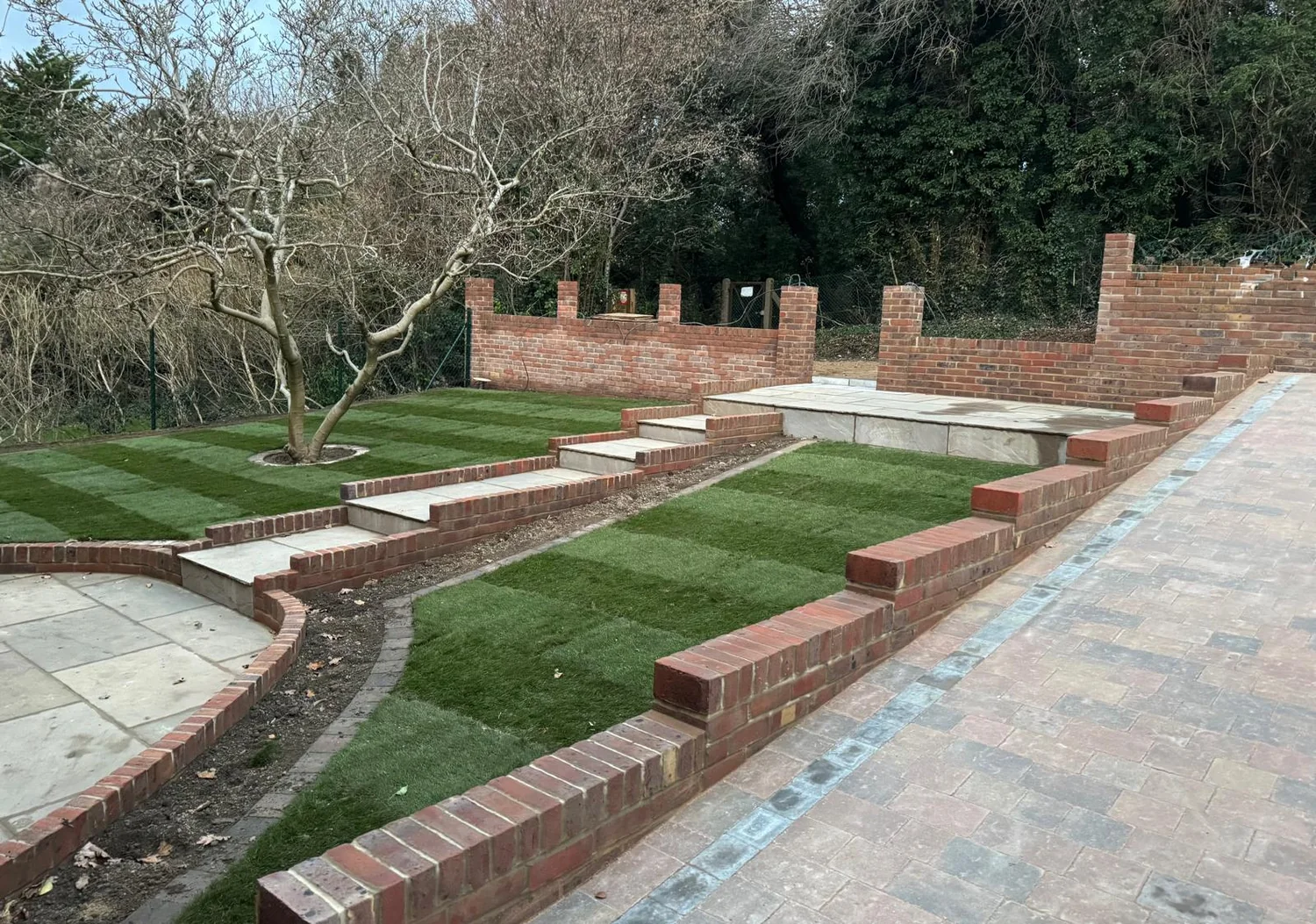
Large Format Greys
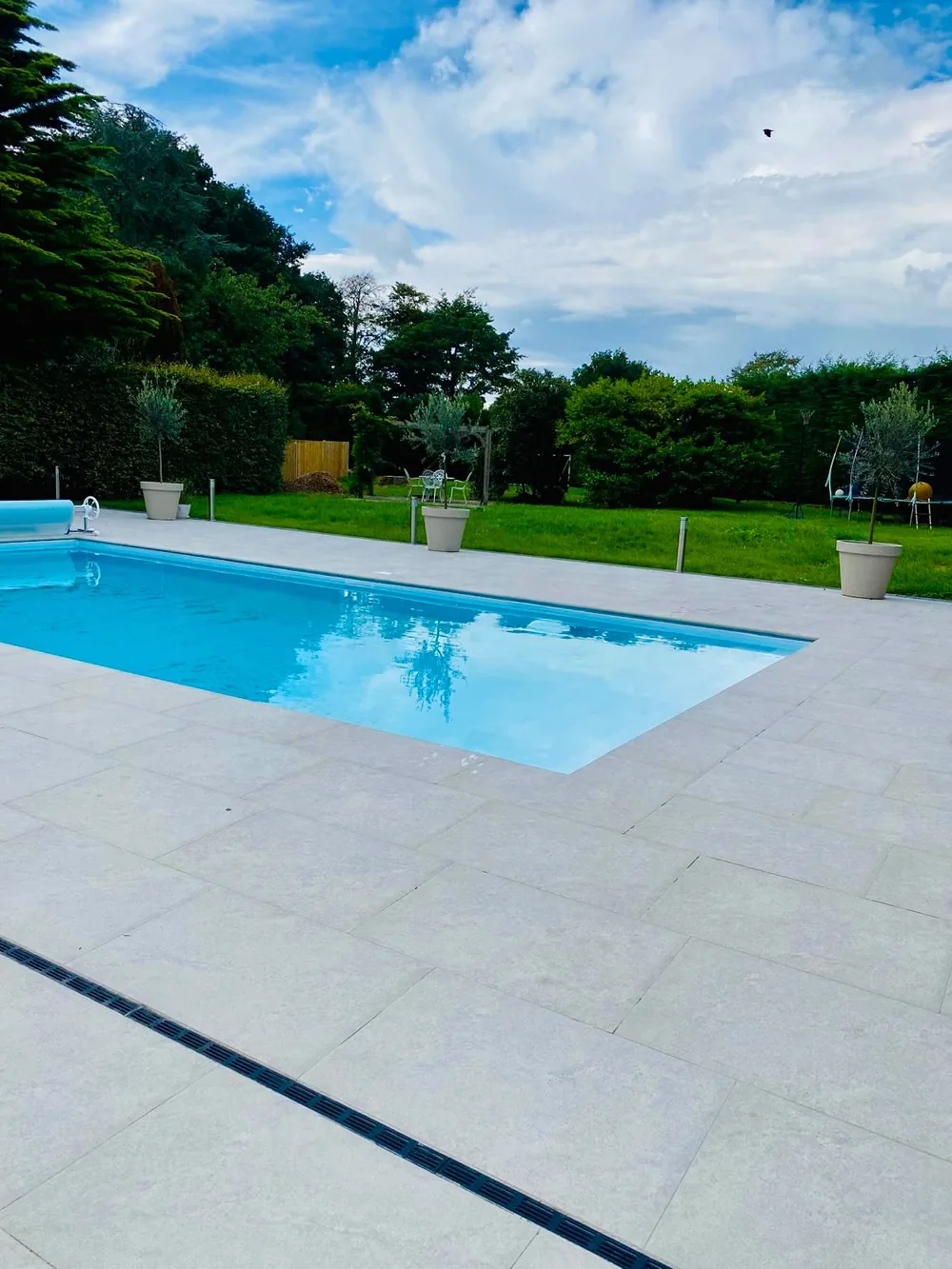
Slabs at 900 by 600 in the light and mid greys most people ask for. Fewer joints across the terrace, so the surface reads as one floor rather than a grid. They are heavy, and they want a bed to match.

 CROCKETT & CROCKETTPAVING LTD
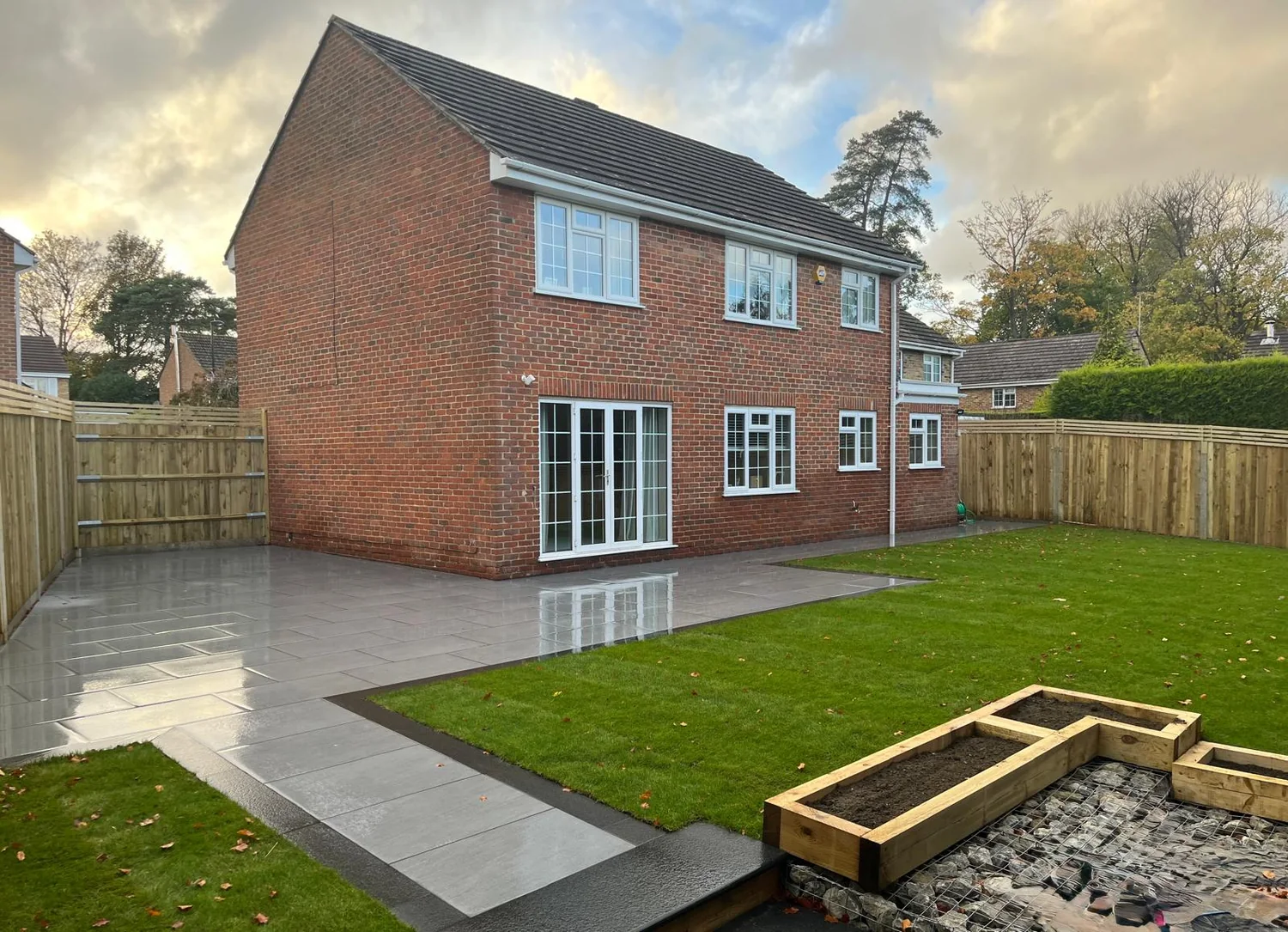
Porcelain paving
Porcelain paving combines clean architectural styling with durability and low maintenance, making it an excellent choice for contemporary patios, terraces and complete garden transformations.
Formats
Scroll, and the terrace re-tiles a format at a time. Or press one.
600 × 600The workhorse. Square, quick to set out, and the joints line up with the doors on most houses. Grid or stretcher.
600 × 900A longer slab that reads calmer on a big terrace. Laid stretcher bond with the long side across the view, it makes a narrow garden look wider.
600 × 1200Large format. Fewer joints, more sky in the reflection, and it needs a perfectly flat bed or it rocks. We only lay it on a full mortar bed with a primer.
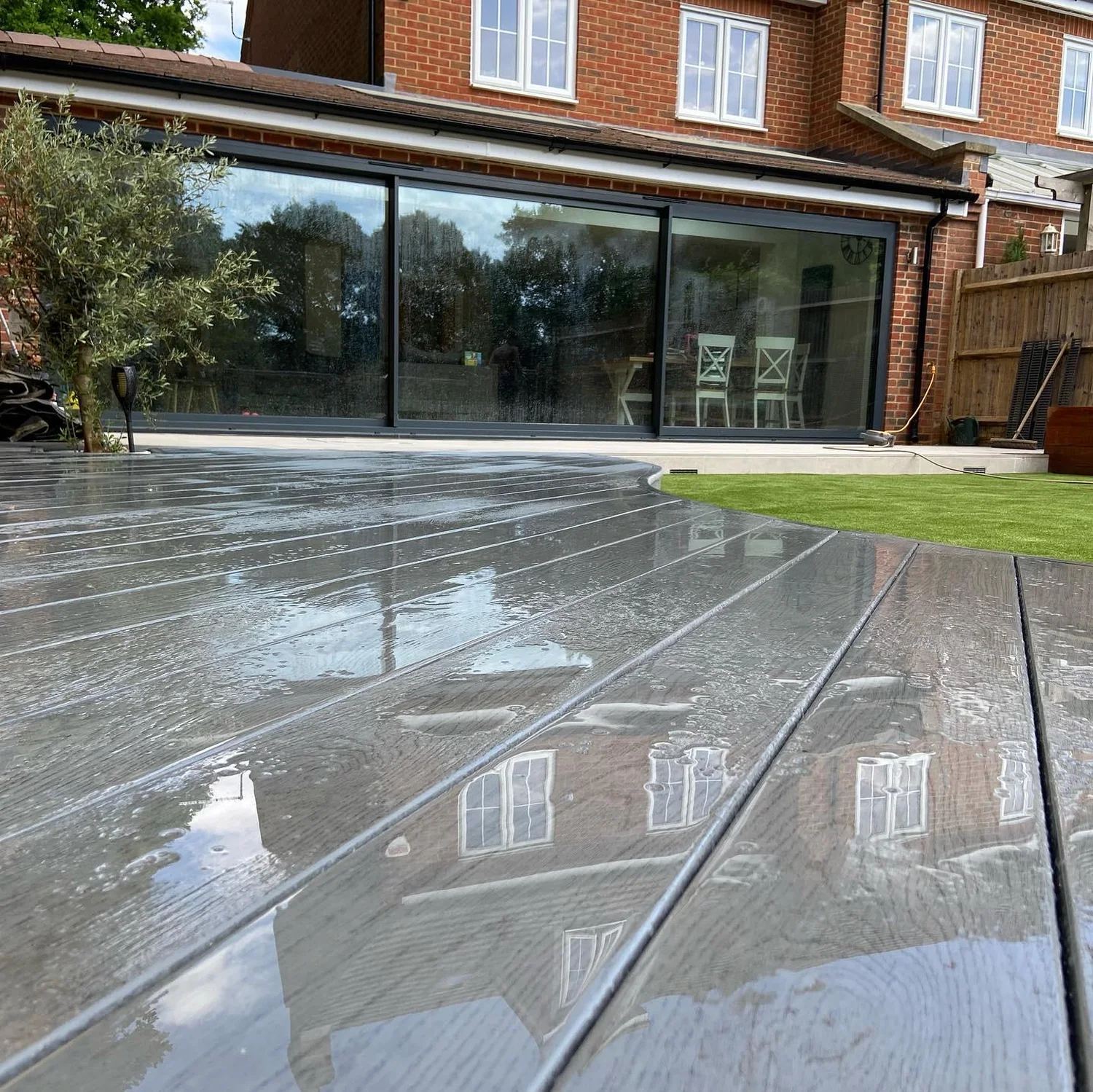
200 × 1200 plankWood effect porcelain in planks. All the look of a deck with none of the rot, and it wants a fall of 1 in 80 so it never holds water.
Our approach
Built properly. Finished beautifully.
Available in a wide range of colours, textures and formats, it can be used to create a refined outdoor space that complements both modern and traditional properties.
Porcelain requires accurate preparation and installation. Foundations, levels, falls, drainage, joint alignment and finishing details are carefully considered to create a consistent and professionally finished surface.
The material
Outdoor porcelain is made 20mm thick for a reason. The 10mm boards sold for kitchen floors have no business outside, where a slab takes point loads from table legs, ladders and a loaded barrow. Twenty millimetres, fully bedded, carries all of that. The same slab left unsupported at one corner will snap.
The edges are rectified, ground square after firing rather than left as they came from the kiln, which is why porcelain can be laid to a 5mm joint and still read as a machined floor. It also means any lippage between one slab and the next shows badly. The material hides nothing for you. Most outdoor ranges carry a textured R11 face, and some go to R12 for pool surrounds and shaded steps.
The bed
Under the paving we take off the topsoil, dig to firm ground, lay a geotextile membrane over the formation and compact MOT Type 1 in layers, usually 100mm to 150mm depending on what the dig turns up. Soft spots get dug out rather than filled. The whole surface is set to a fall of about 1 in 80 away from the house.
The slabs go onto a full bed of wet mortar, screeded flat so there is contact under the whole slab, and the back of every slab is painted with a slurry primer before it is set down. That primer is the bond. Five dabs under the corners leaves voids, voids fill with water, and water in a void freezes, rocks the slab and chips the edge.
Cutting is the other place porcelain catches people out. It has to be cut wet, with a continuous rim diamond blade, slowly. Dry cuts chip the glazed face and leave an edge you can see from the kitchen window. Curves, treads and drain surrounds are all cut by hand on site.
Inside and out
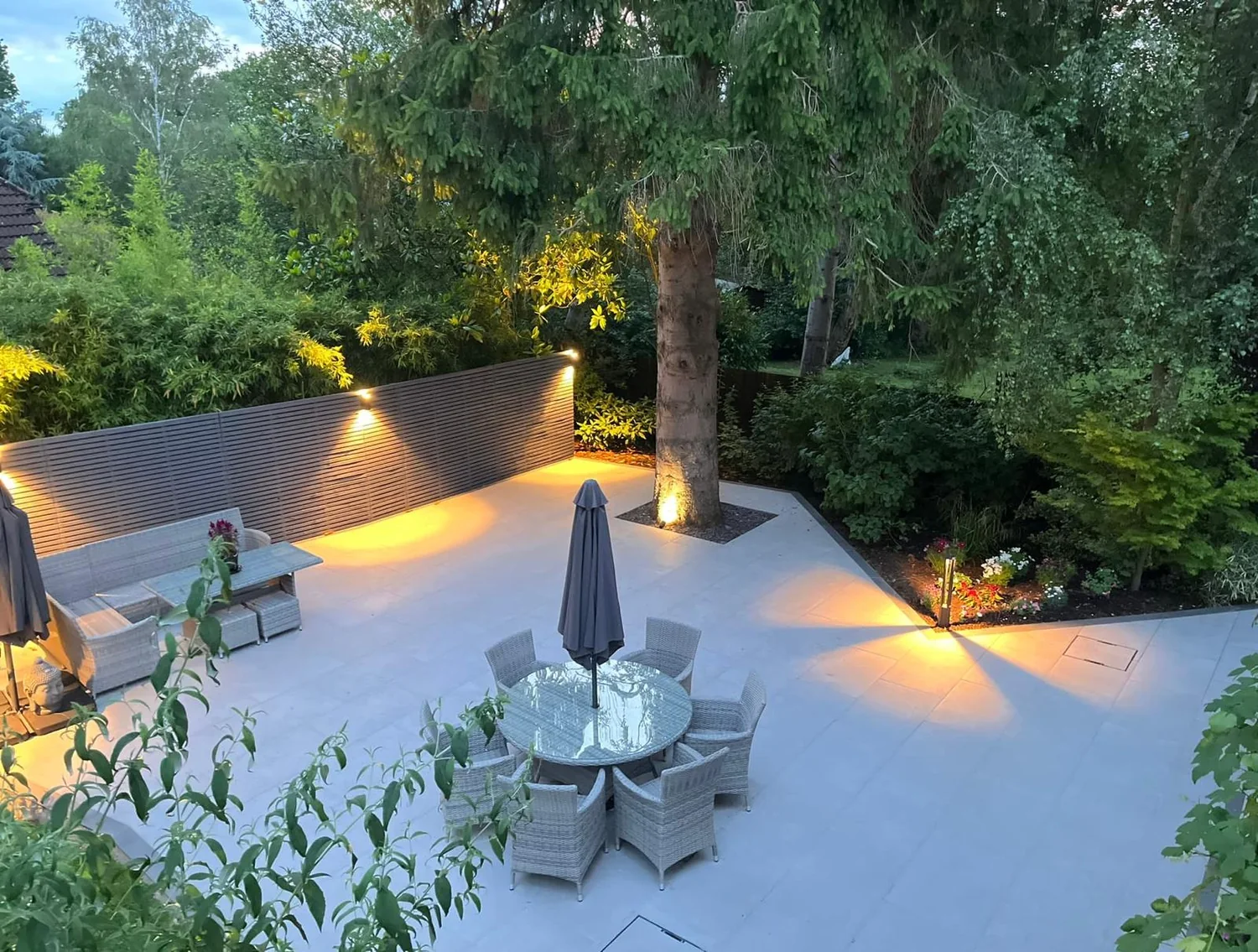
Most ranges are made as a 10mm indoor tile and a 20mm outdoor slab in the same colour and the same face, so the kitchen floor can run through the doors and out onto the terrace. It is worth deciding before the bi-folds go in, because the internal floor level and the outside levels have to be set out together.
A level threshold needs care. Paving normally sits about 150mm below the damp proof course so driven rain cannot get into the wall. To bring the terrace up flush you put a channel drain across the opening, take it to a proper outfall and keep the fall running away from the building. Done properly it stays dry. Added as an afterthought it puts water into the house.
What you can have
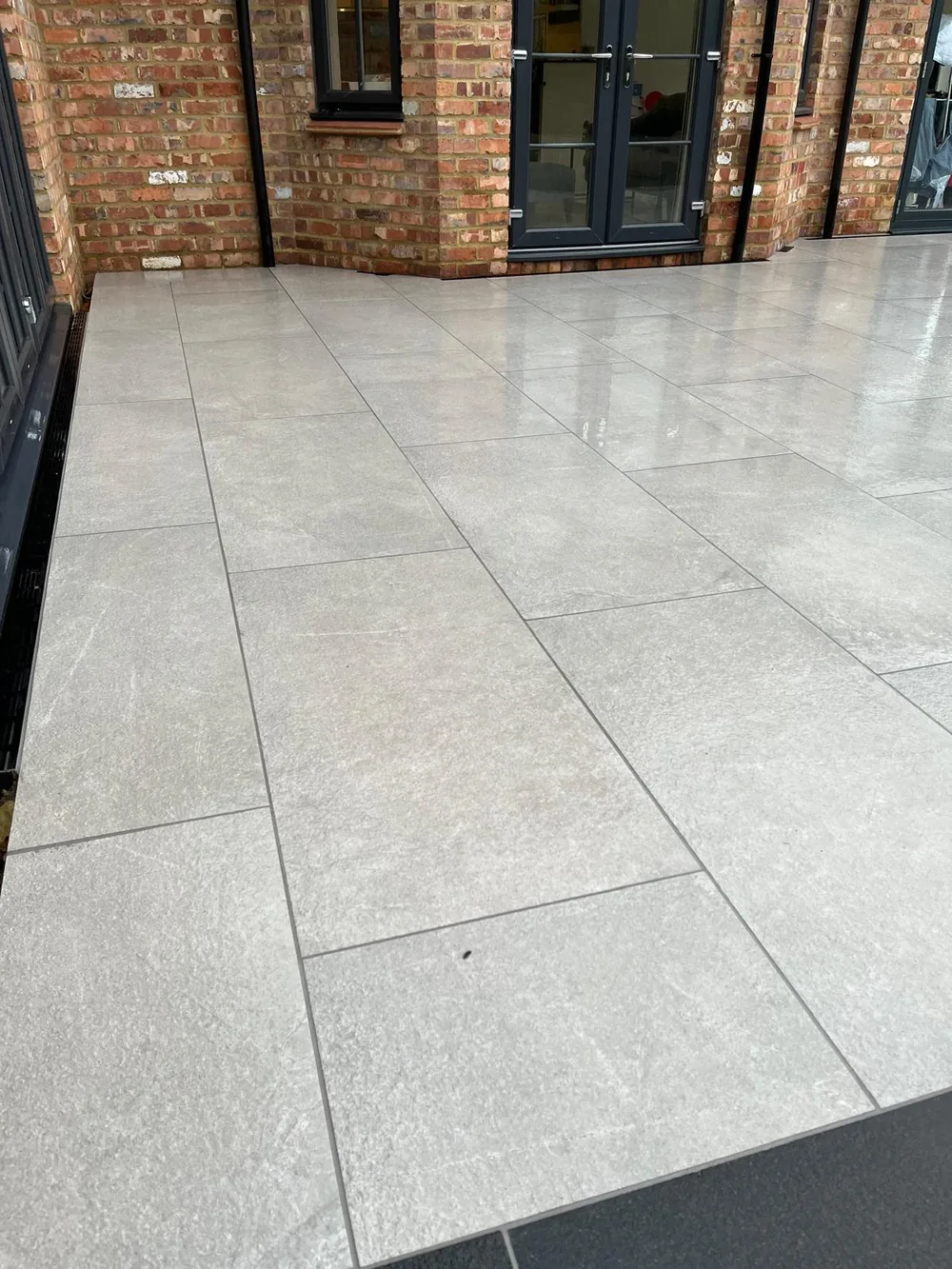
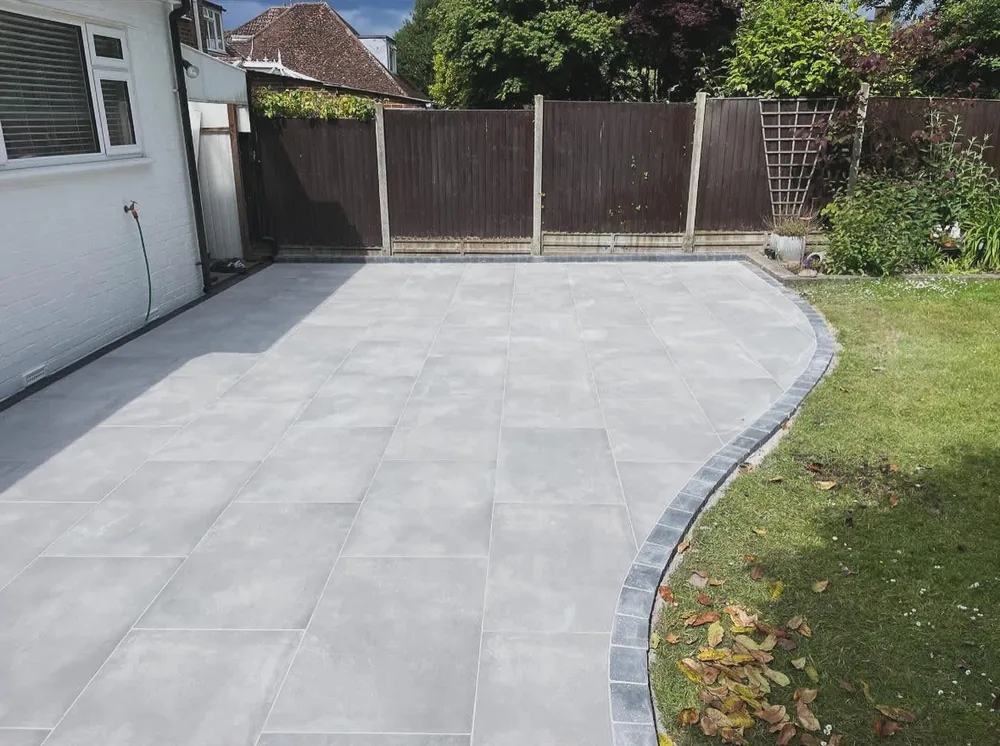
Slabs at 900 by 600 in the light and mid greys most people ask for. Fewer joints across the terrace, so the surface reads as one floor rather than a grid. They are heavy, and they want a bed to match.
Long thin porcelain planks with a printed grain, laid stretcher bond or herringbone. They look like decking from three paces and behave like porcelain in every way that matters: no rot, no splinters, no annual oiling.
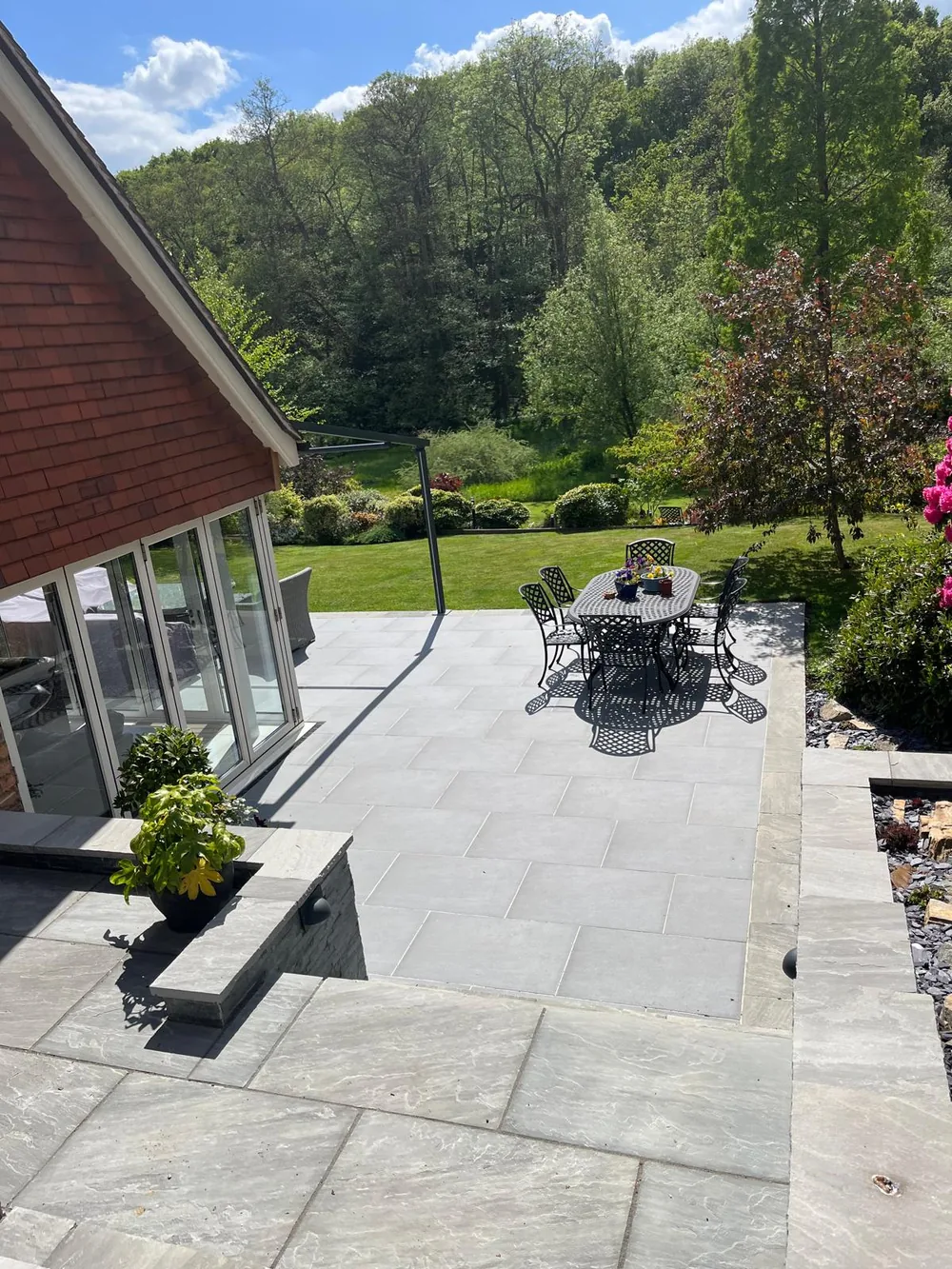
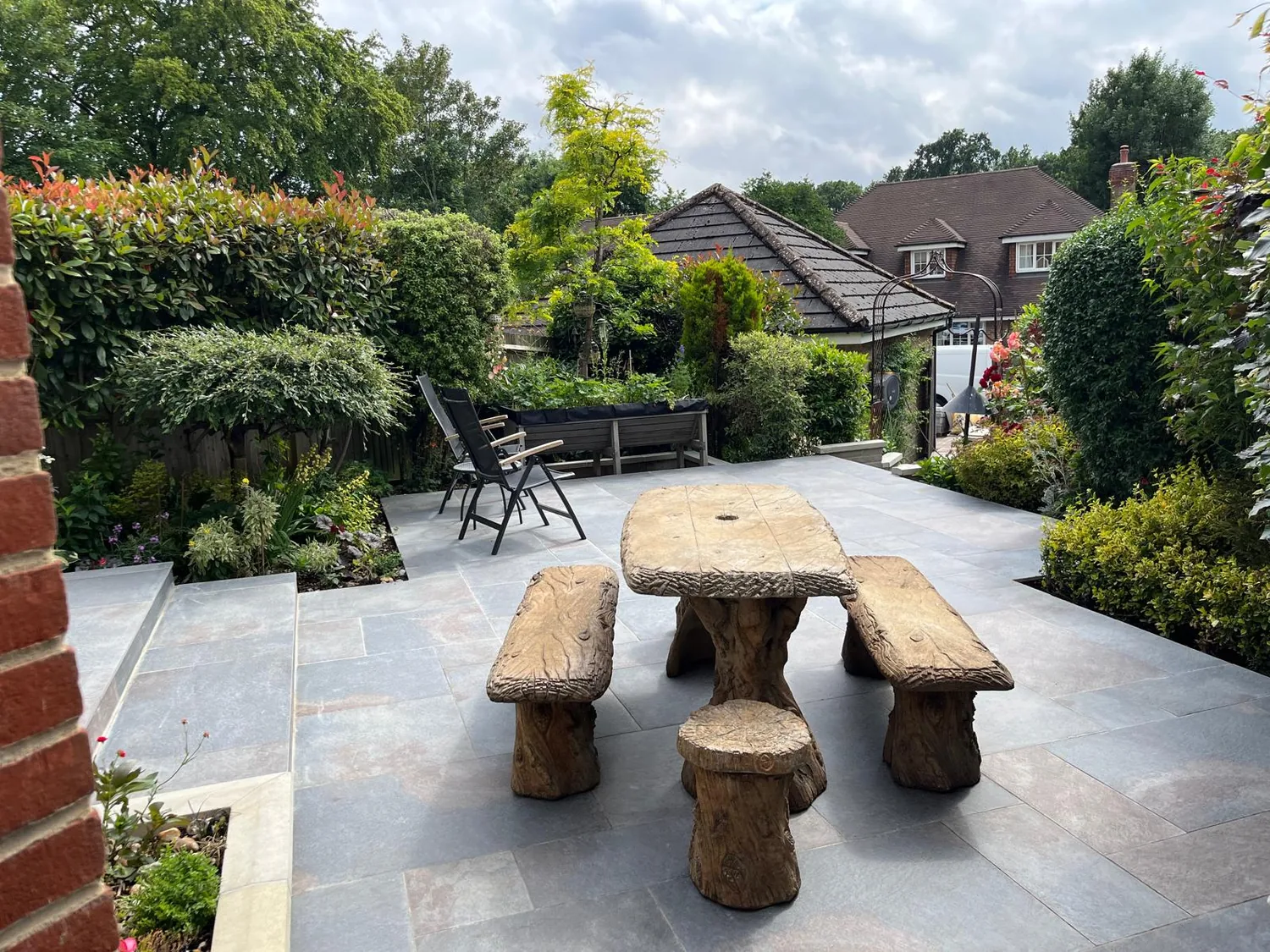
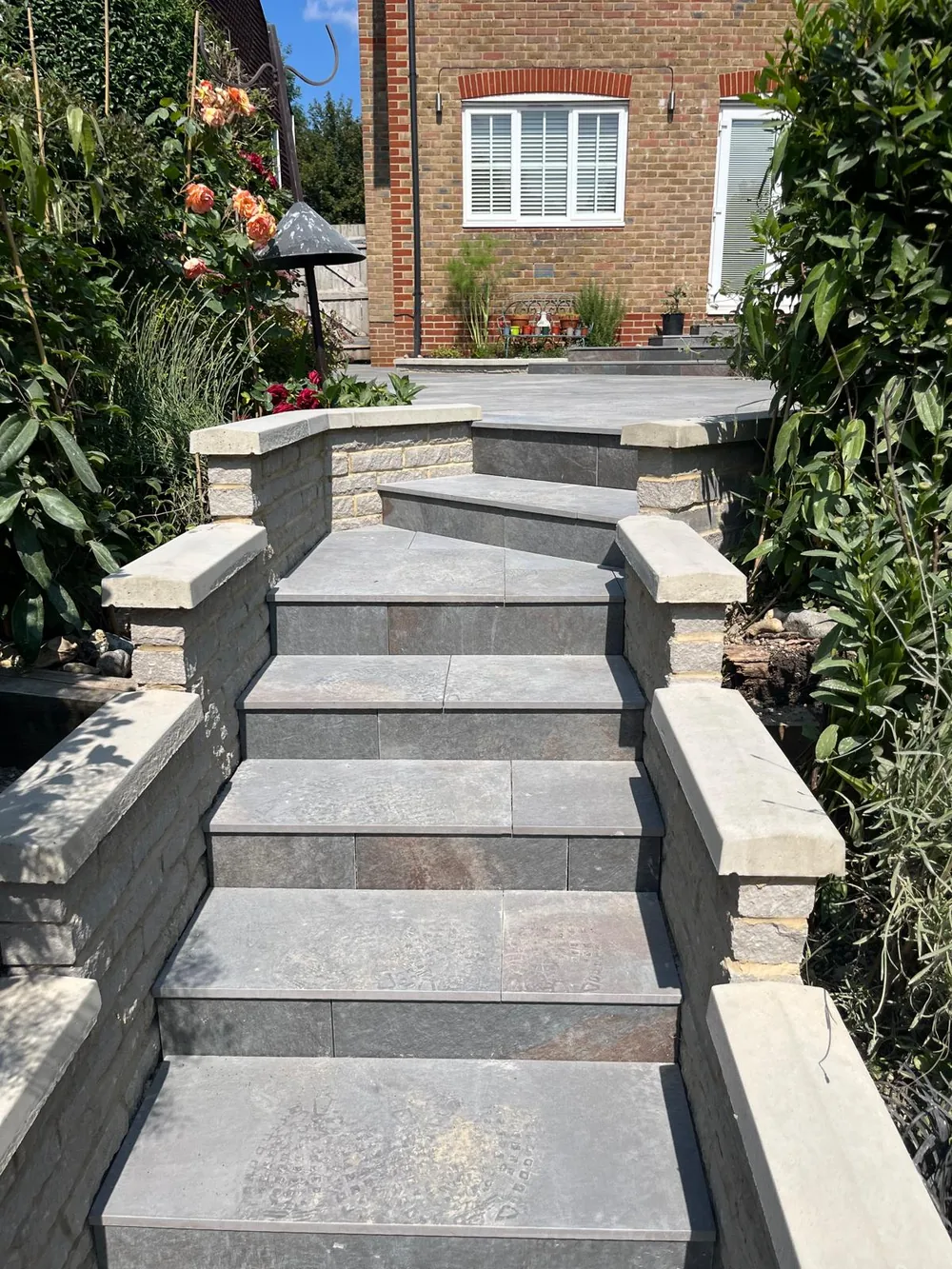
Sandstone and slate faces reproduced in porcelain, for gardens where a machined grey would sit oddly against old brick. You get the look of stone without the soaking, the salt bloom or the iron staining.
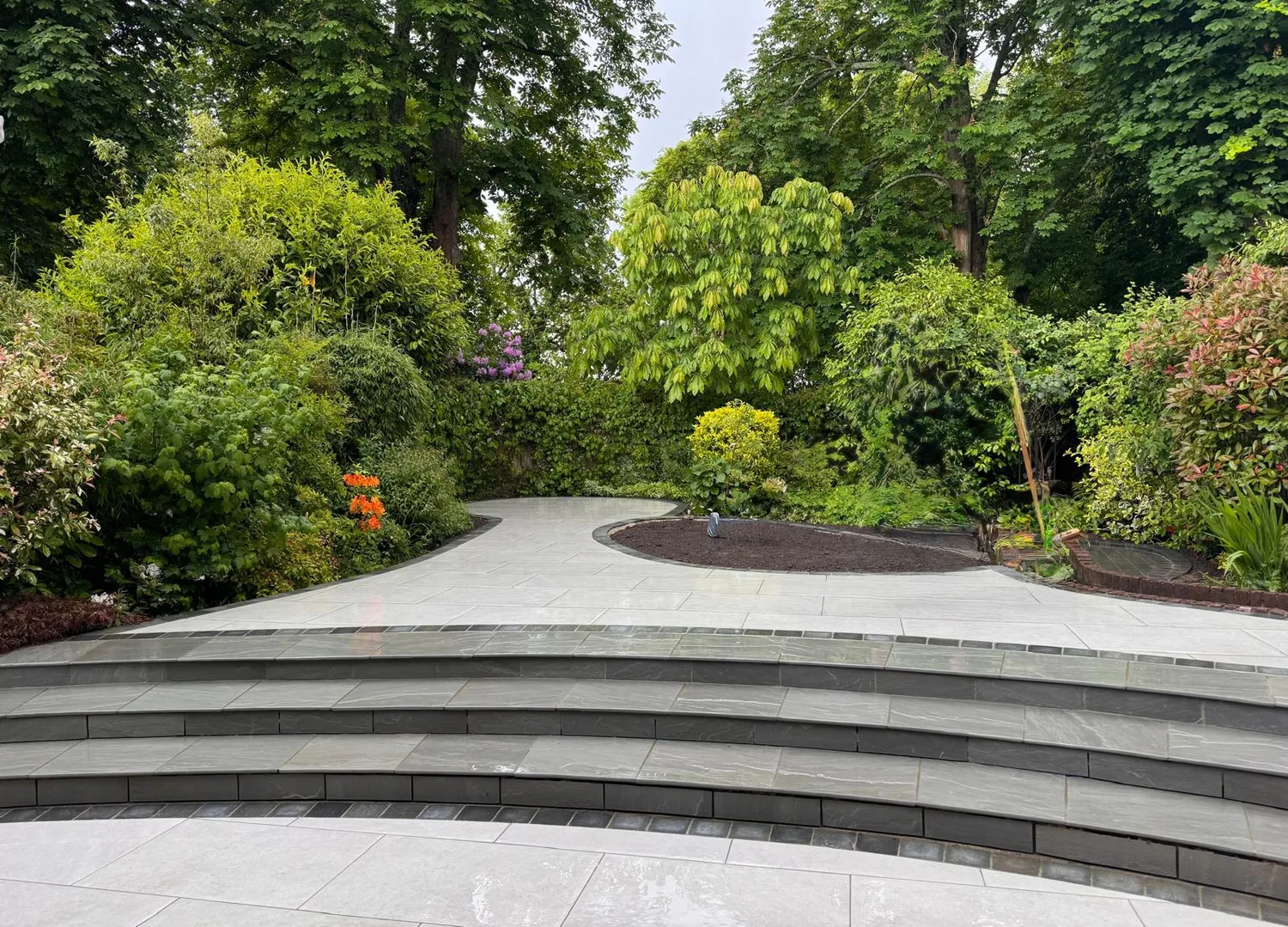
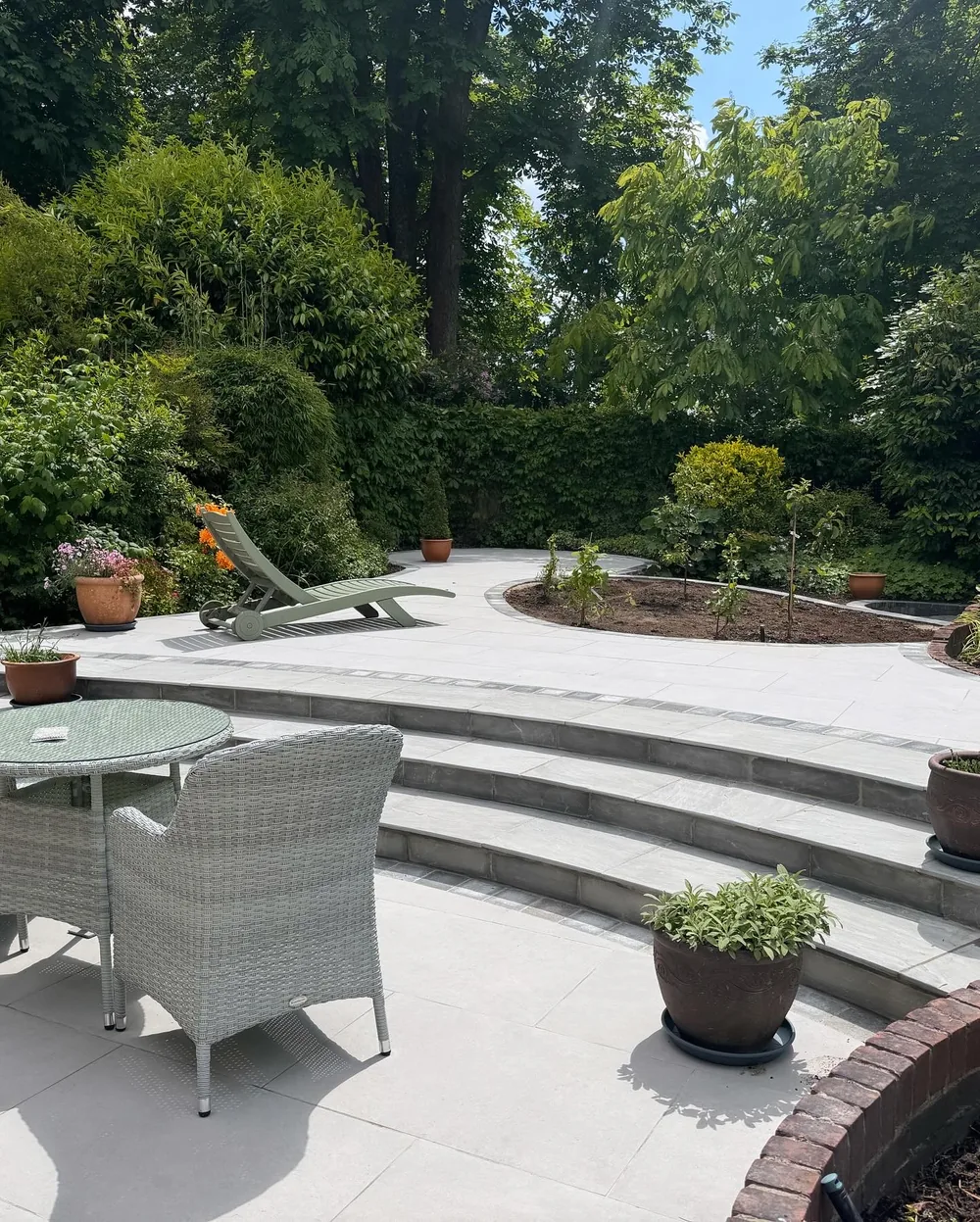
Matching bullnose treads, coping for a raised terrace and porcelain risers, all cut on site. Steps take more punishment than the patio, so the brickwork and the haunching underneath get built to carry it.
The terrace brought up flush with the kitchen floor, with a slot channel across the opening and the fall running away from the house. It needs deciding early, because it sets the levels of everything behind it.
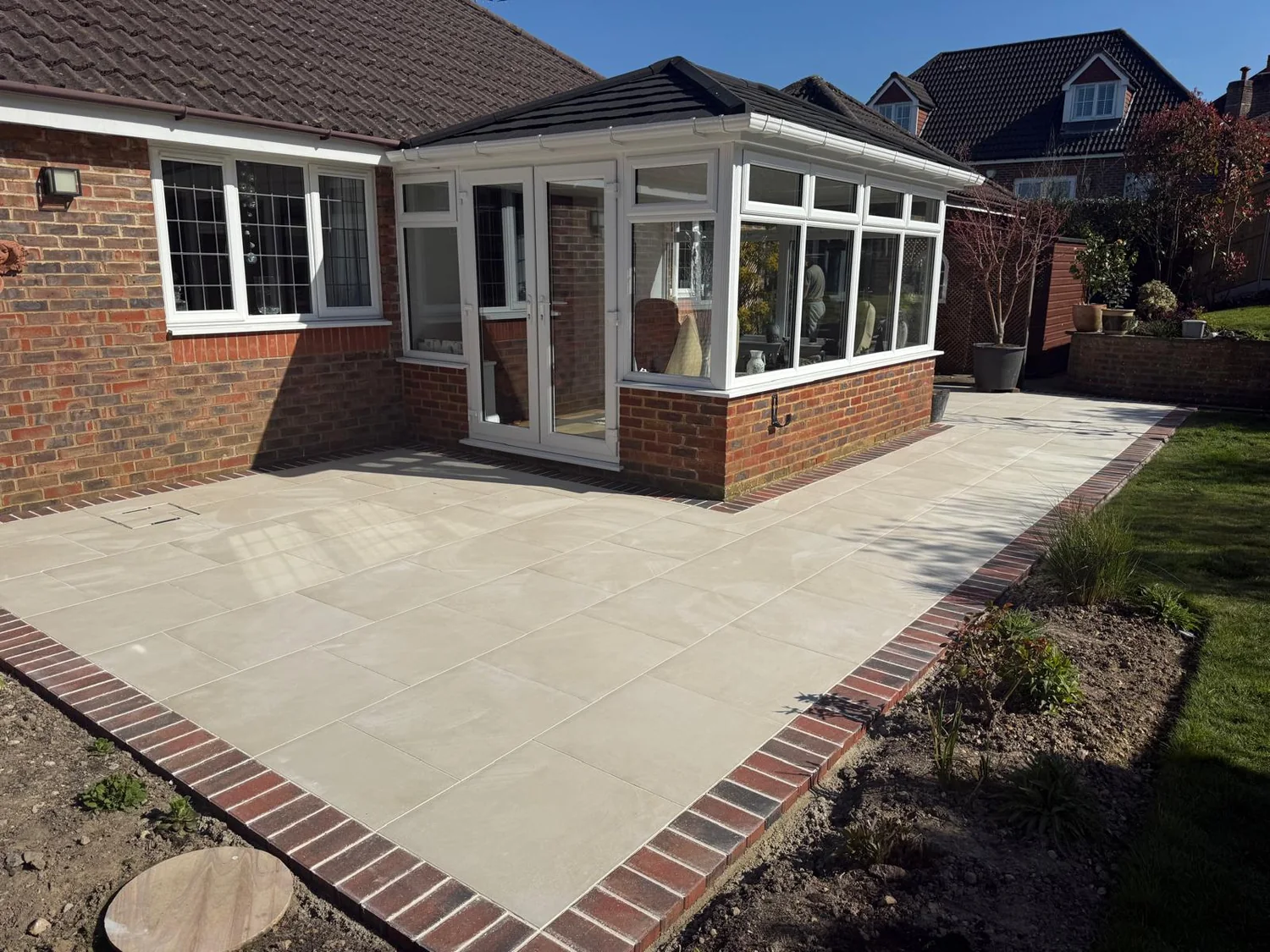
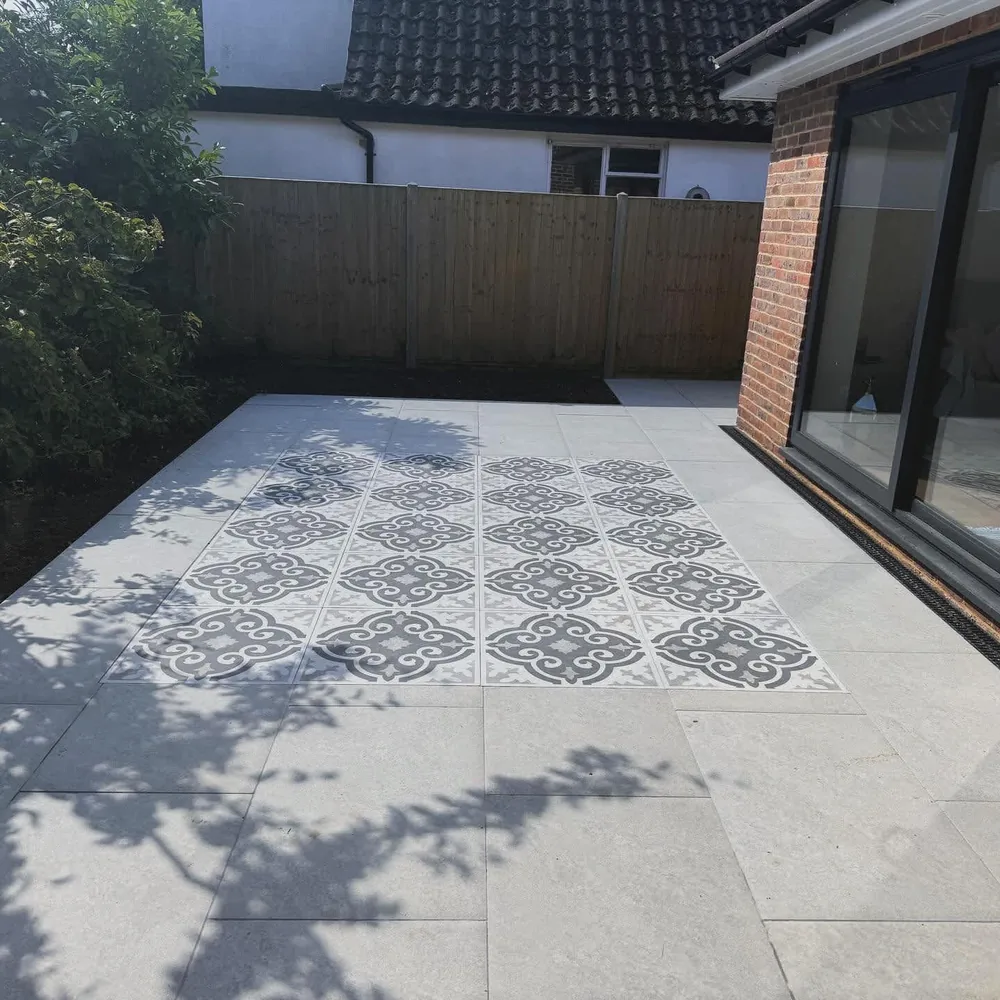
A contrasting band around the edge, a path cut into the lawn, or a strip of setts to break up a large area. It tidies the perimeter and gives every cut slab a clean line to die into.
Questions
Because porcelain absorbs almost no water, mortar cannot key into the back of it the way it keys into sandstone. So the slab is bonded rather than soaked in, using a slurry primer on the back of every slab set into a full bed of wet mortar. Spot dabs leave voids underneath. Voids hold water, water freezes, the slab rocks and the corners chip.
Outdoor porcelain is made with a textured face and most ranges carry an R11 slip rating, with some pool and shower ranges going to R12. It is a fair question, because polished indoor tile is dangerous outside. Check the rating of the range you have picked, and tell us if the patio is on a slope, in permanent shade or next to a pool.
No. Sealers work by filling pores, and a vitrified slab has almost none, so there is nothing for a sealer to sit in. That is one reason people choose it over sandstone and limestone, which do benefit from sealing and need reapplying every few years. Porcelain wants a wash down and the joints kept intact, and that is about it.
Usually, yes. Most ranges are produced as a 10mm indoor tile and a 20mm outdoor slab in the same colour, size and face, so the floor can run through the doors and onto the terrace. It works best decided before the doors go in, because the internal floor level, the damp proof course and the threshold drainage all have to be set out together.
It depends on the size, the slab you pick, how much digging out there is, whether there are steps or walls, and where the spoil can go. A flat lawn behind a wide side gate is a different job from a sloping garden with barrow access only. We come out, measure, look at the ground and give you a free written quote with the work itemised.
For a normal domestic terrace, count on one to two weeks from the first spade to the last joint, weather allowing. The dig and the base take longer than most people expect and the laying goes quicker. Mortar and jointing compound both need dry conditions to go off properly, so we will not rush the last two days to hit a date.
Frost damage happens when water gets into a material, freezes and expands. Porcelain gives water almost nowhere to go, so a properly bedded slab is not troubled by a Surrey winter. The colour is fired in at high temperature rather than dyed on, so it holds in sunlight. What does crack porcelain is a void underneath it or a base that has moved.
For most houses, laying or replacing a patio at ground level is treated as permitted development and needs no application. It can be different for a listed building, in a conservation area, or where the terrace is raised well above the surrounding ground. Drainage matters too, since water should not be sent onto a neighbour's land. If there is any doubt we will say so and point you at the council.
Our work
Get a quote
We are on the Marshalls Register of Accredited Landscape Contractors and Driveway Installers, a London Stone registered installer and a Bradstone assured installer, with 10 out of 10 on Checkatrade. Show us the garden and we will tell you what the ground needs before we talk about slabs.
Arrange a free site visit
Tell us a little about the project and we will come out, look at the ground and put a written quotation together.
Where we work
Based in Caterham, we undertake projects throughout Surrey and selected areas of Kent and West Sussex. For larger or more comprehensive projects, we are happy to consider work further afield.