

Reigate, RH2
Driveways and Patios in ReigatePriced off What We Find in the Dig, Not off a Plan
Reigate sits low in the Vale of Holmesdale with the Downs rising hard behind it. Sand under one street, stiff Gault Clay under the next, and old sand mines under the middle of town. Two drives half a mile apart are not the same job.
Working in RH2
One Town, Several Different Kinds of Ground.
Reigate lies at about 80 metres in the Vale of Holmesdale, below the North Downs escarpment, and the strata change over very short distances. The town centre and Reigate Heath sit on the quartz rich Folkestone Beds of the Lower Greensand. The higher ground at Priory Park is on the clayey Sandgate Beds and the sandy Hythe Beds. North of the railway there is a band of stiff blue black Gault Clay, and at the foot of the Downs a thin outcrop of Upper Greensand and then chalk.
That decides more about your driveway than the colour of the block does. The sandy ground to the south and west digs easily and will usually take a soakaway, but it runs as soon as it is open, so trench support, thin compacted layers and a haunched edge matter more than digging deep. The Gault Clay around Wray Common shrinks, swells and holds water, so it wants a deeper stone sub-base and falls taken to a positive outfall.
We are Crockett & Crockett Paving, a family-run company at 393 Stafford Road in Caterham, run by Oli Crockett. The dig, the drainage, the base, the edging and the laying are all delivered and managed by Crockett & Crockett. 27 years in the trade, accredited on the Marshalls Register of Accredited Landscape Contractors and Driveway Installers, a London Stone registered installer and a Bradstone assured installer, and 10 out of 10 on Checkatrade. Free written quotes, fully insured, insurance work undertaken.
What is under the front garden
Greensand on One Side of the Railway, Gault Clay on the Other.
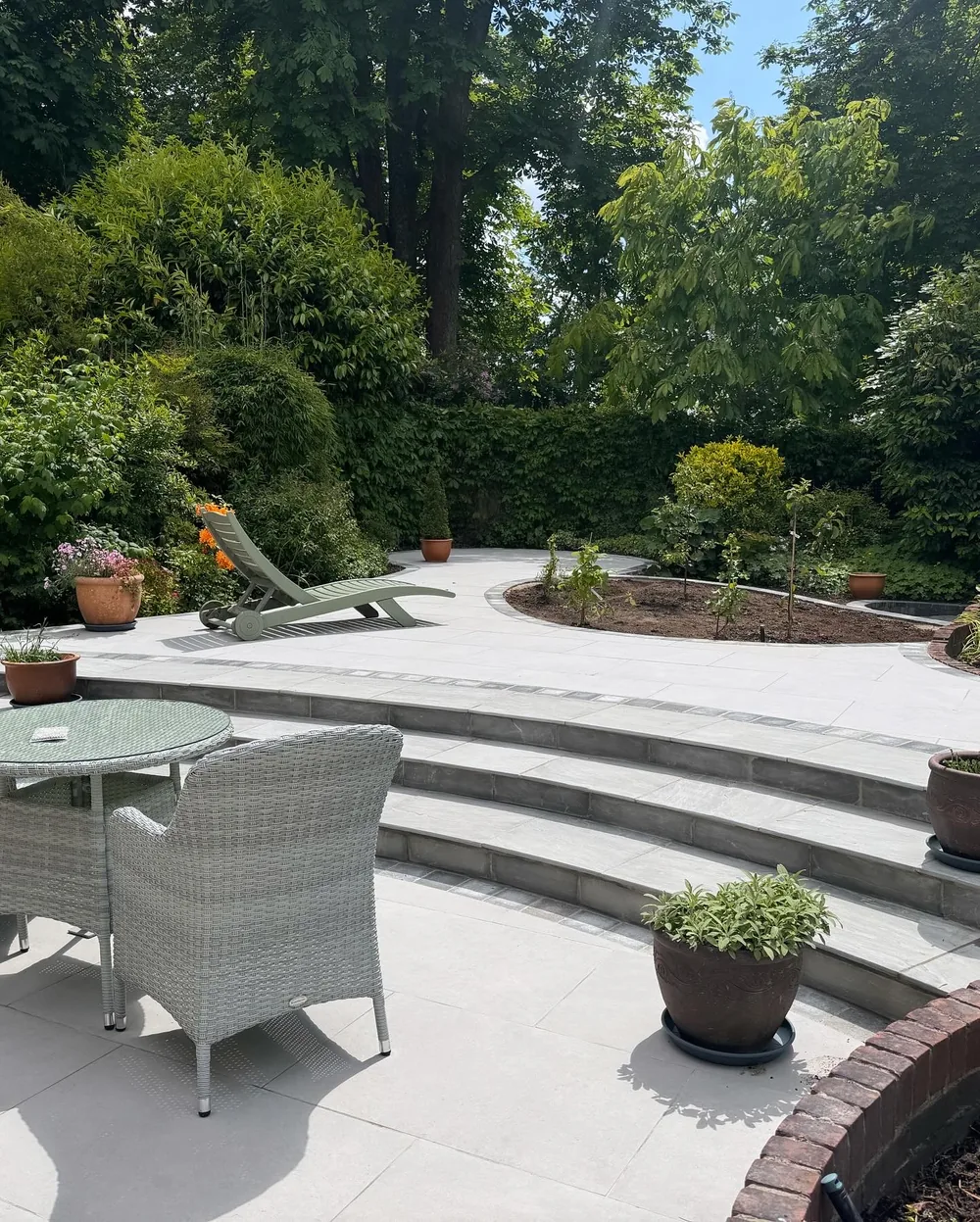
Open the ground in South Park, Doversgreen or towards Reigate Heath and you are usually into free draining sand. It digs quickly and will normally take a soakaway. The catch is that sand does not stand up: trench sides run, the formation loses shape under traffic, and a drive without a properly haunched edge spreads at the margins within a few winters. North of the railway, and around Wray Common at about 120 metres, it turns to stiff blue black Gault Clay, which holds water, swells in winter and shrinks back in summer. That wants deeper stone, a formation never worked wet, and water taken to a positive outfall.
Two local things sit on top of the geology. The town centre is undermined by the old silver sand mines known as the Reigate Caves, where a large fall in 1858 left the sunken garden between the Town Hall and the Castle Grounds. The councils' joint flood risk assessment also records increased susceptibility to groundwater flooding west of Reigate. Neither stops the work. Both are reasons to open the ground and look before pricing a drainage design.
- Folkestone Beds sand south and west: quick digging, usually a soakaway, supported trenches and thin compacted layers.
- Gault Clay north of the railway and around Wray Common: deeper stone sub-base, falls to a positive outfall.
- Chalk and Upper Greensand at the foot of the Downs: formation protected and capped the same day it is opened.
- West of Reigate, where groundwater flooding susceptibility is on record, we check the outfall first.
The houses
Three Kinds of Frontage, and Three Completely Different Jobs.
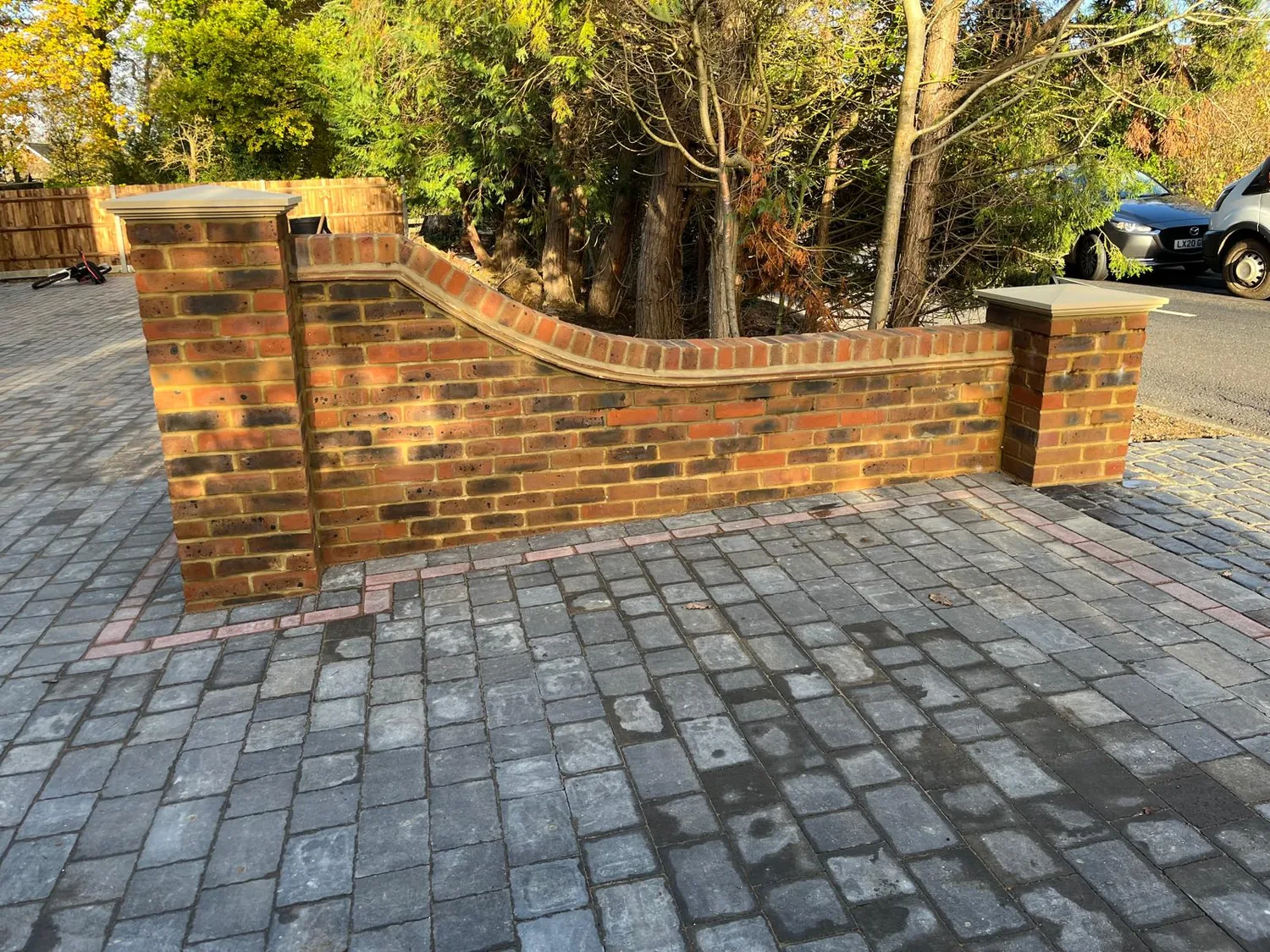
The oldest fabric is the town centre around the High Street, Bell Street, West Street and Castlefield Road, where the building line sits close to or at the back of the footway and there is often no front garden at all. Work there is rear terraces, side access, walls and piers rather than driveways. Victorian expansion followed the railway in 1847: the Wray Park estate was laid out from the 1850s, substantial mansions went up around Wray Common Road in the 1880s, and by the 1900s the plots were smaller again.
The borough's design guidance describes the Victorian and Edwardian streets near the centre as having front gardens of roughly two to five metres, heavy on street parking and boundaries up to about 1.2 metres, and names Hardwick Road as a street that kept its character because the front gardens stayed small. Interwar growth went south into Woodhatch after the sale of the Reigate Priory estate in 1921, with council housing at Rushetts Farm. The Wray Common and Reigate Hill side is the opposite: long gravel drives, unkerbed side roads and real level change.
- Town centre: no front garden to speak of, so rear terraces, side gates, brickwork and piers.
- Victorian and Edwardian streets: two to five metre frontages, low boundaries, real parking pressure.
- Wray Common and the hill roads: large plots, unkerbed lanes, gravel approaches and serious level change.
What we do most in Reigate
Drives That Fit the Frontage, Terraces That Sit Level on Ground That Does Not.
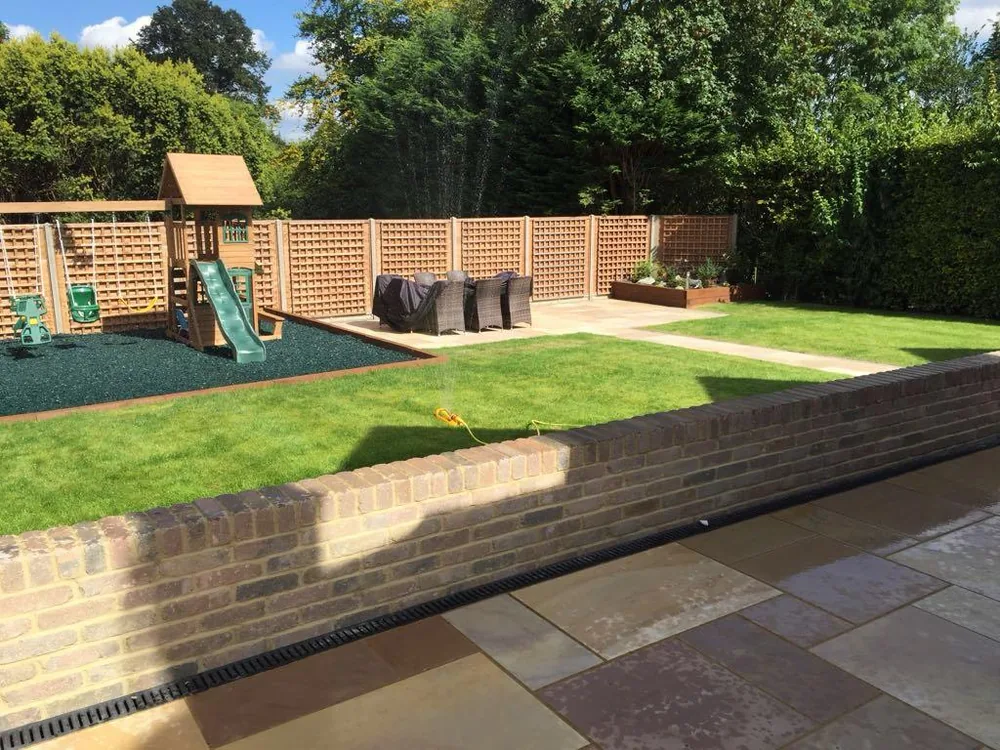
On the Victorian streets it is usually block paving. Small units work round a bay window, a manhole and a front path without a run of ugly cuts, and a permeable build keeps the water on your own plot rather than pushing it into a road that is already parked solid. On the newer frontages at Woodhatch and South Park we lay a great deal of resin, and we are often asked to put right a shallow drive laid straight onto old concrete with no edge and no fall.
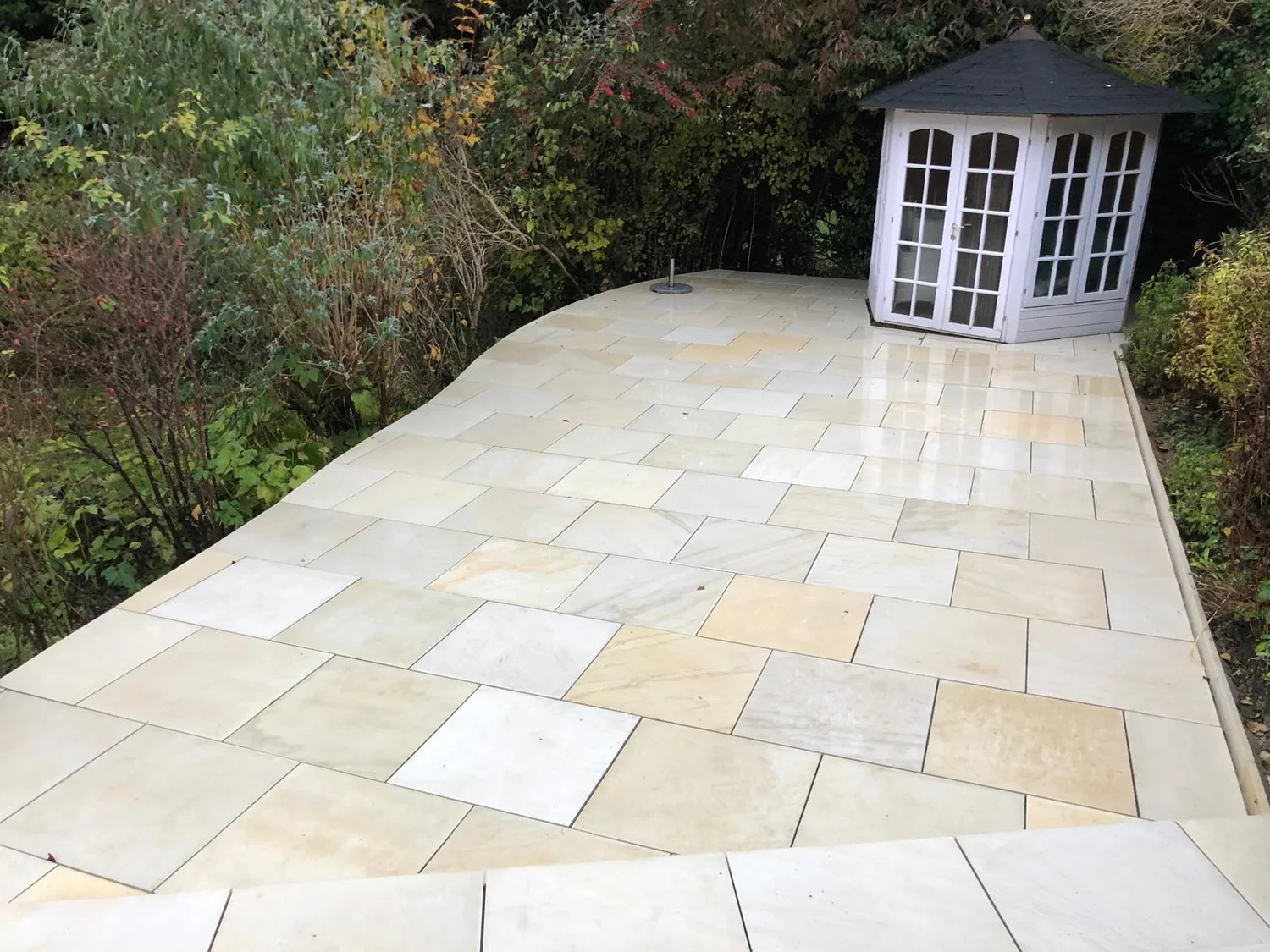
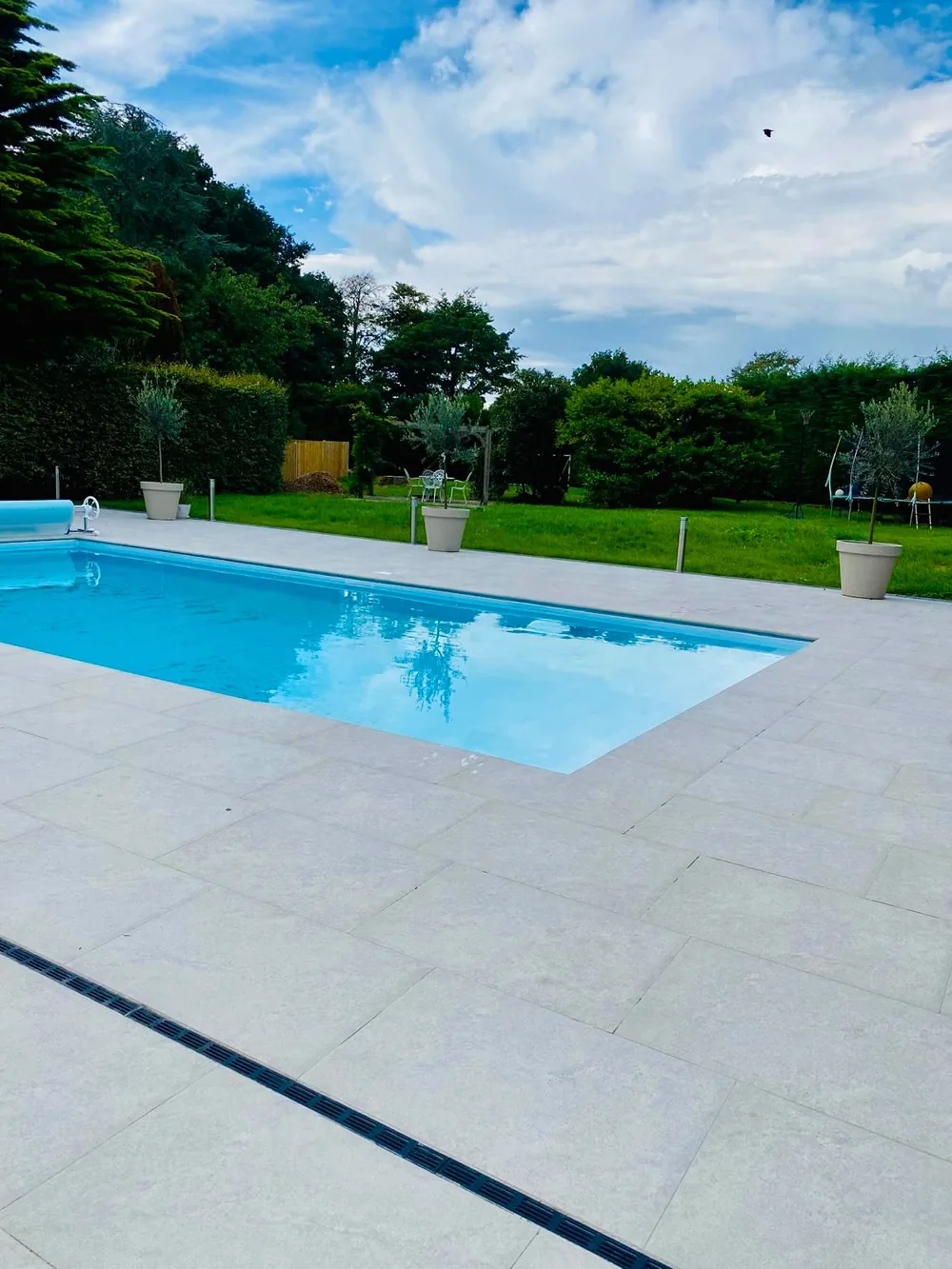
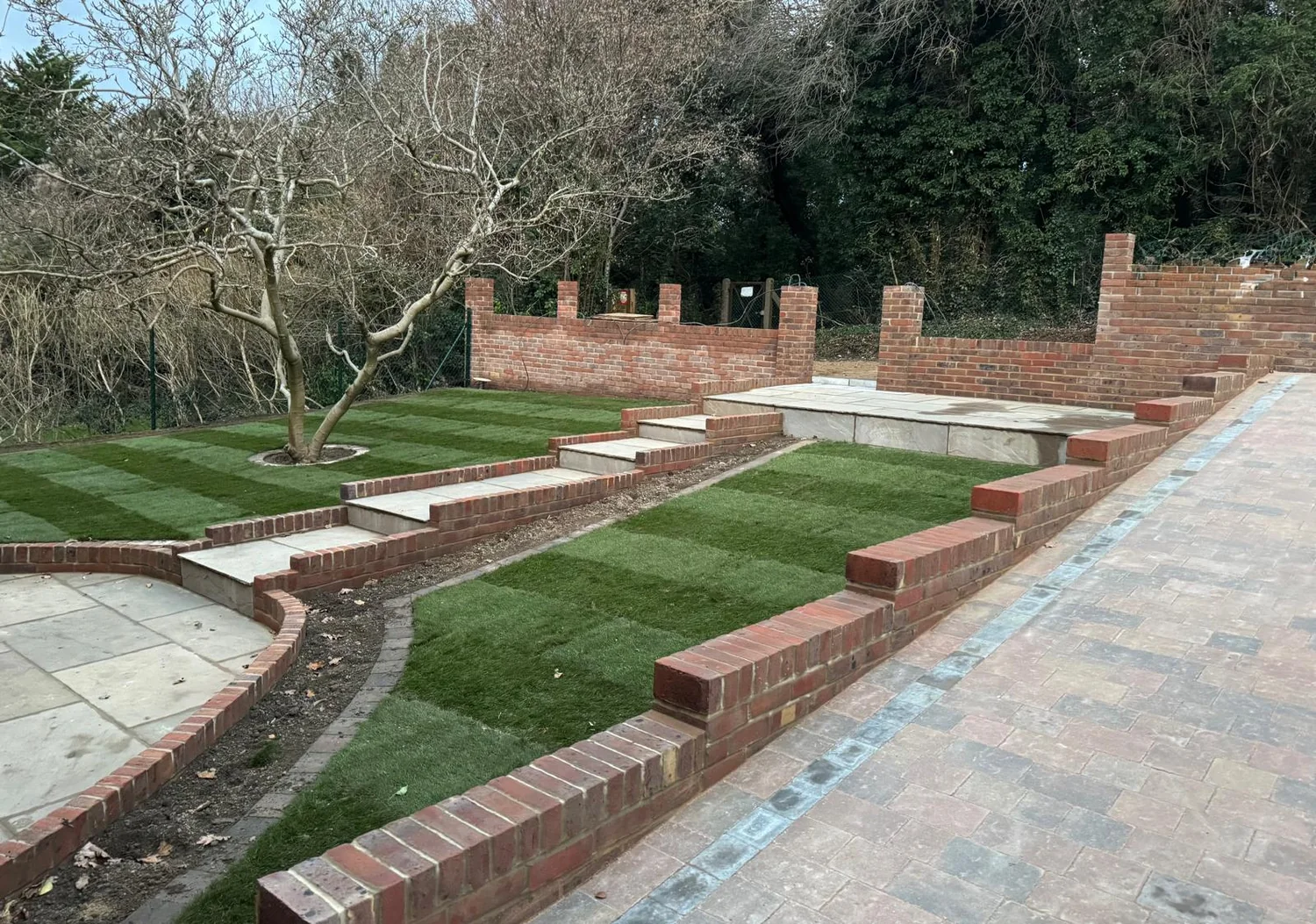
Uphill the work changes character. Frontages on Reigate Hill and Cockshott Hill mean stepped drives, retaining and gradients that still have grip in January. Retaining is not decoration there. It holds the platform your car parks on, so it gets a proper foundation, drainage behind it and weep holes, then a face to suit the house. Behind the house, Reigate gardens take porcelain and sandstone terraces, garden rooms, brick walls, fencing and turfing, and on the clay side the base under a garden room matters as much as the building on it.
- Block paving driveways on tight Victorian frontages, cut round bays, paths and covers.
- Resin surfaces over a sound, correctly drained base on the streets south of the centre.
- Retaining walls, steps and level platforms on the Reigate Hill and Cockshott Hill frontages.
- Porcelain and sandstone terraces on a full bed, with falls running away from the house.
- Garden room bases, drain runs, brick piers and fencing to finish the garden.
Access, levels and permissions
Reigate and Banstead for Planning, Surrey County Council for the Kerb.
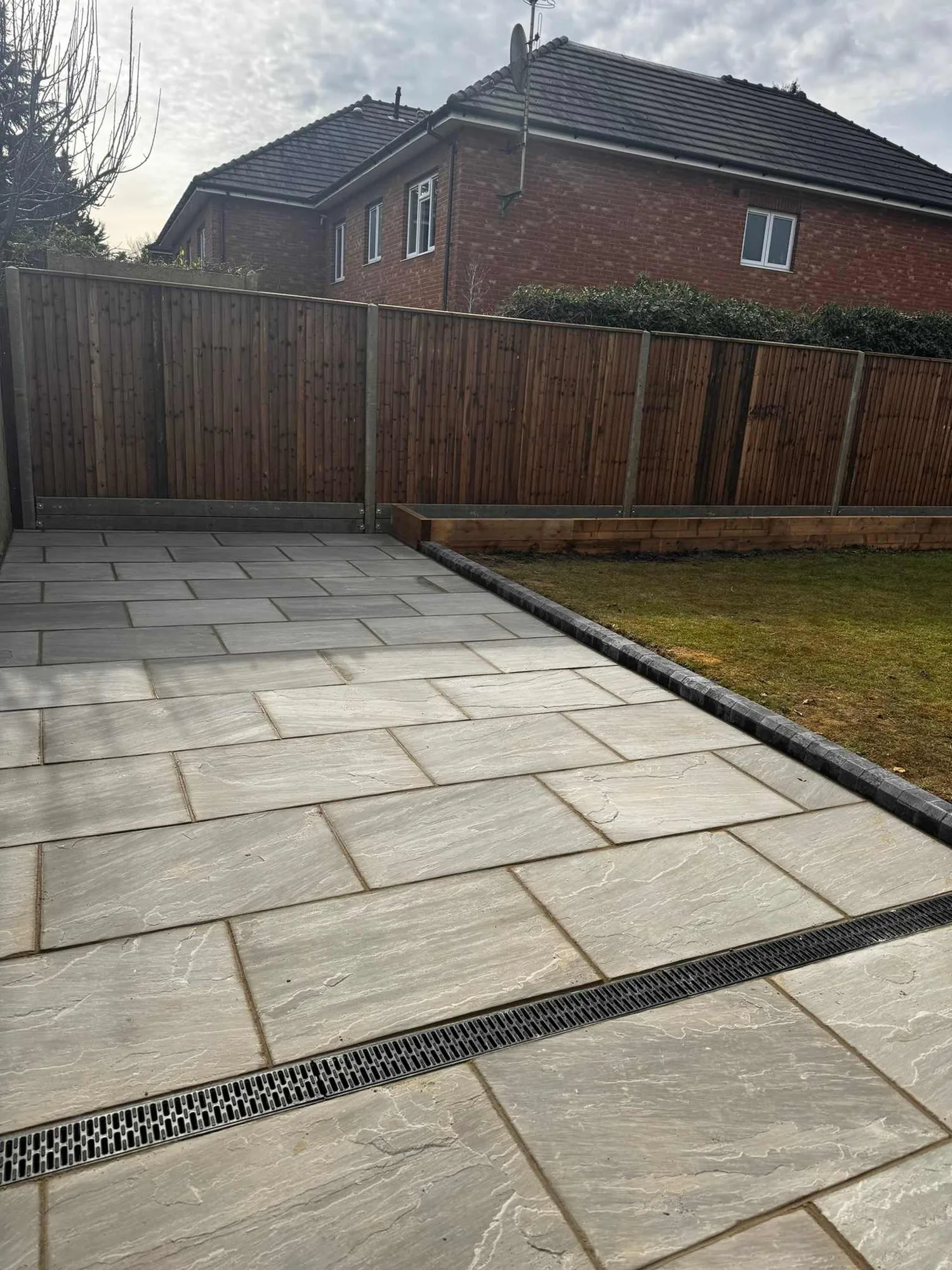
The two jobs are separate. A vehicle crossover needs a licence from Surrey County Council, only their approved contractors may work in the highway, and the county asks for the approved planning application or written confirmation from the borough that permission is not needed, which it says can take up to six weeks. Surrey quotes a stage one fee of 383 pounds, not refundable, average build costs of around 1,800 pounds, and a licence valid for six months. Worth starting early rather than the week before you want the drive laid.
On the surfacing, Planning Portal guidance says a driveway of any size needs no permission where it uses permeable or porous surfacing such as gravel or permeable concrete block paving, or where rainwater is directed to a lawn or border, while an impermeable driveway over five square metres that does not drain to a permeable area does. That is national guidance, not a Reigate rule. Access matters too: the A25 runs through as West Street, High Street, Bell Street and London Road, and the A217 climbs Reigate Hill, so deliveries and muck away get planned round the traffic.
- Planning: Reigate and Banstead Borough Council. Highways and crossovers: Surrey County Council.
- Conservation areas: Reigate town centre, Wray Common, and Flanchford Road and Colley Lane. Article 4 Directions cover most of the borough's conservation areas.
- Green Belt covers roughly 70 per cent of the borough, and the Surrey Hills National Landscape takes in Reigate Hill and Colley Hill.
Villages and neighbourhoods
Where We Work Around Reigate
We cover the whole of RH2 and the villages either side of it, from the flat ground at South Park and Doversgreen to the greensand hills at Skimmington and the Gatton valley under the Downs.
Our work
Work of This Kind
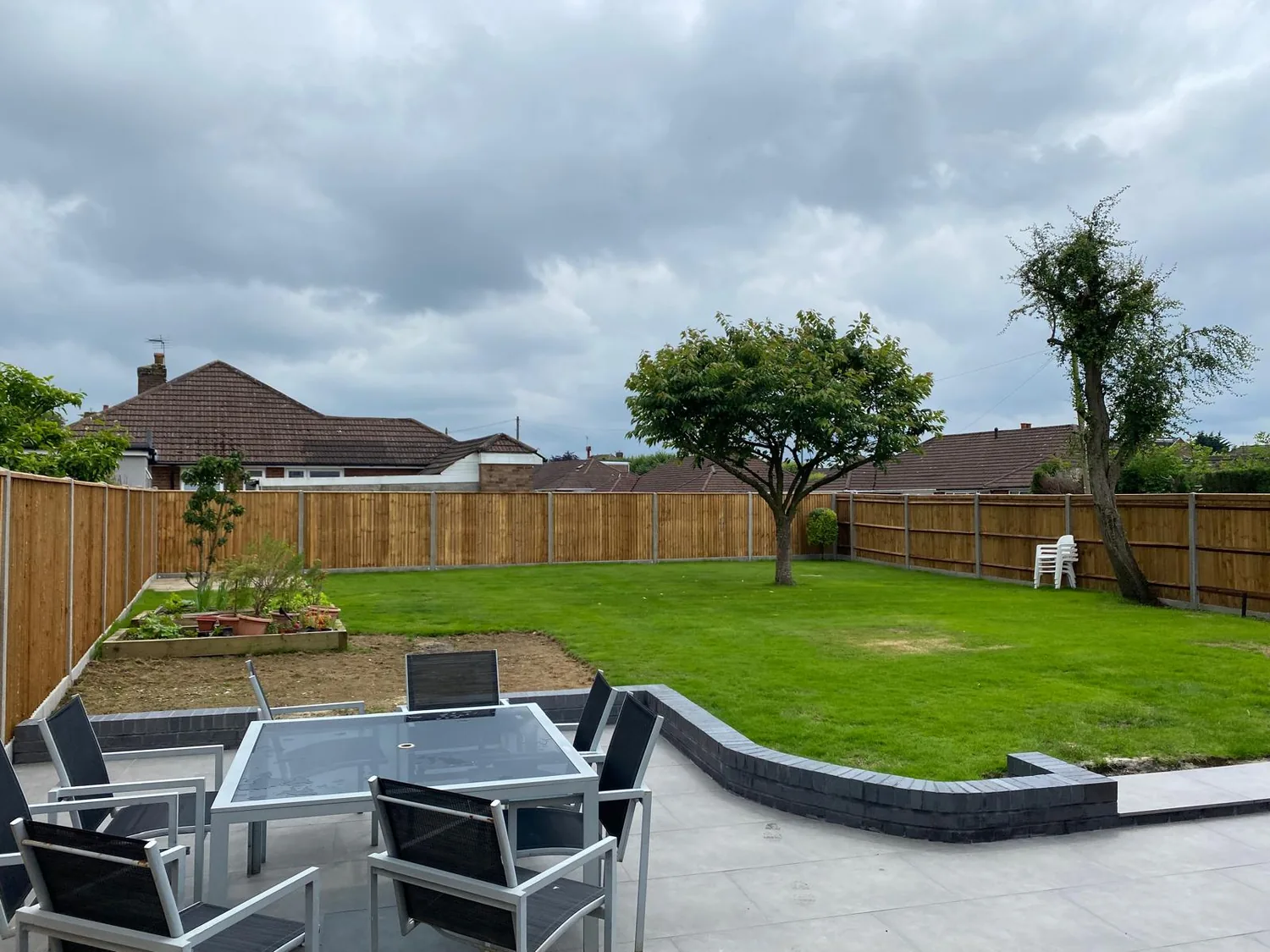
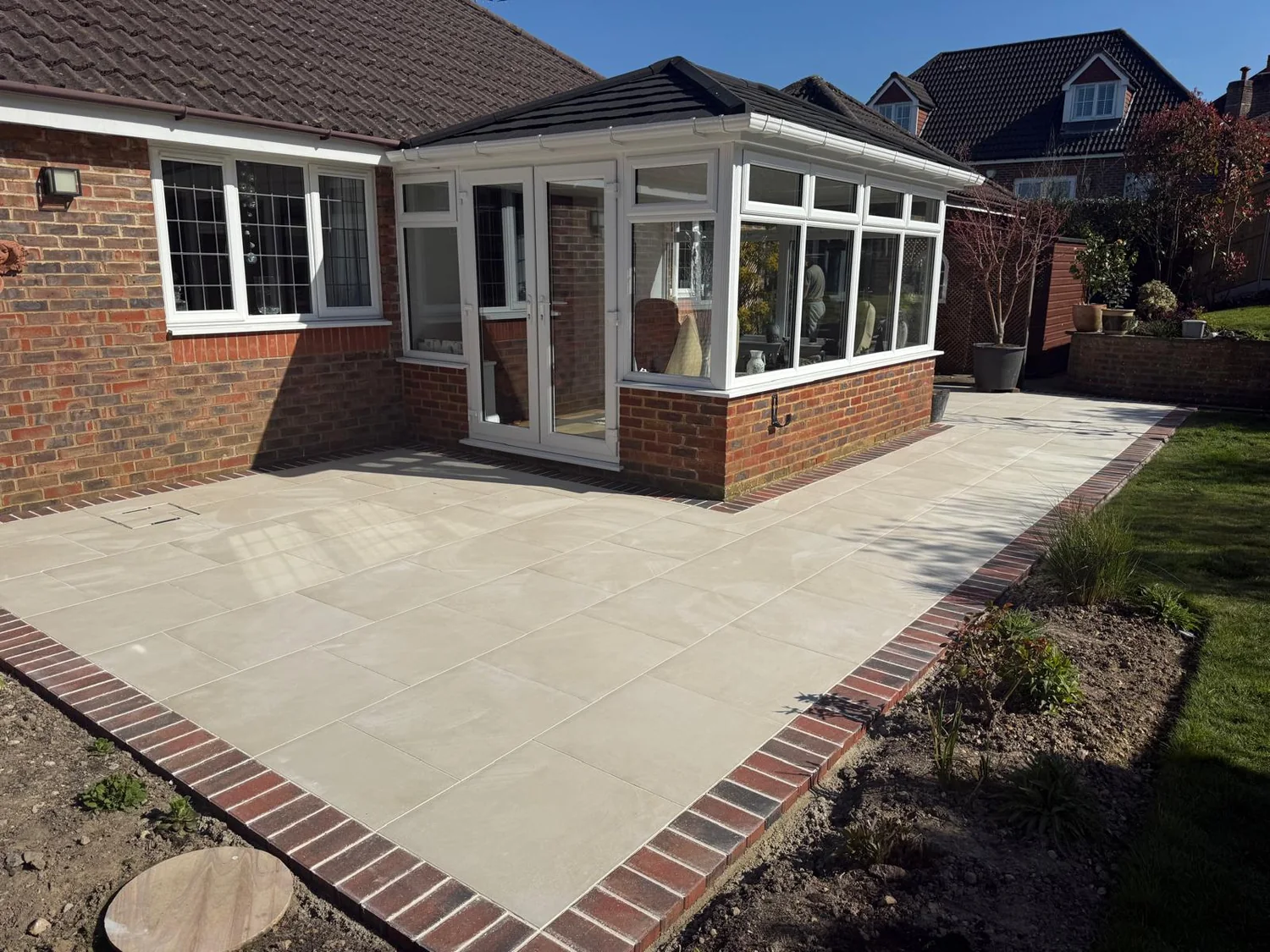
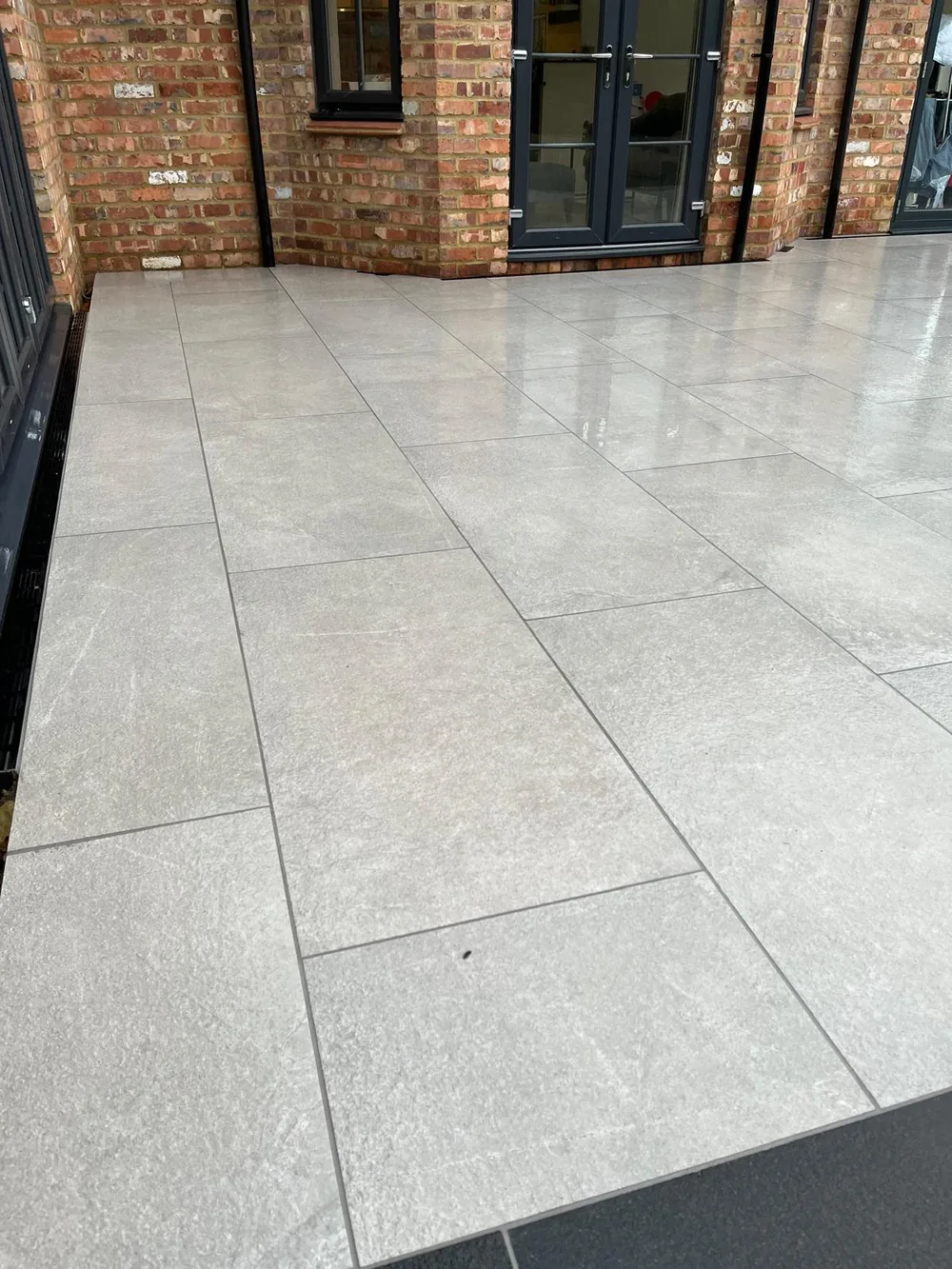
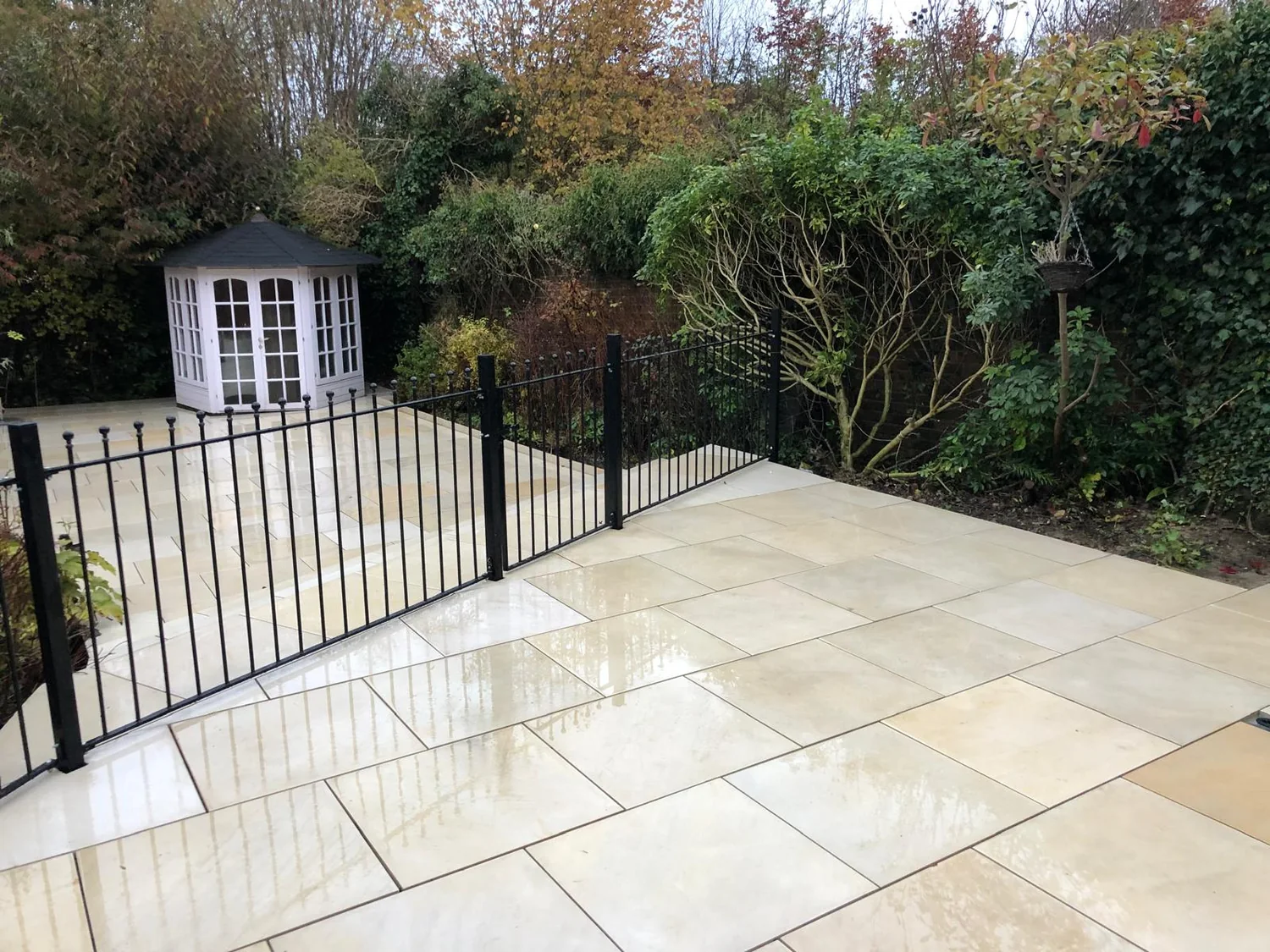
Questions
Reigate Questions We Get Asked
Will a soakaway work at my house in Reigate?
It depends which side of town you are on. The Folkestone Beds sand at Reigate Heath and across the south and west usually drains well enough to take one. The Gault Clay north of the railway and around Wray Common usually does not, and wants a positive outfall instead. We dig a test pit rather than guess.
Do I need planning permission for a driveway in Reigate?
Usually not. National guidance says a driveway of any size is fine without permission if it uses permeable surfacing such as gravel or permeable block paving, or if rainwater runs to a lawn or border. An impermeable drive over five square metres draining to the road does need it, and Article 4 may apply in the conservation areas.
Who do I apply to for a dropped kerb, and how long does it take?
Surrey County Council as highway authority, not the borough, and only contractors on their approved list may work in the highway. They ask for the approved planning application or written confirmation from Reigate and Banstead that permission is not needed, which can take up to six weeks. The stage one fee is 383 pounds.
Our frontage on Reigate Hill is steep. Can we still have a level driveway?
It is a groundworks job as much as a paving job. The ground rises from about 80 metres in the town to roughly 235 metres at Reigate Hill, so those frontages usually need a cut platform, retaining to hold it, and steps to the door. We set the gradient so it still works in ice.
We are in the Wray Common Conservation Area. Do we have to lose the gravel?
No, and we would advise against it. The conservation area appraisal treats gravel drives and the absence of kerbs on the smaller roads as positive features, and gravel is permeable, which suits the clay ground there. If loose stone runs on a slope, resin-bound gravel keeps the same look.
There is only three metres between our Victorian bay and the pavement. Is a drive worth it?
Often yes. The borough's design guidance recognises those two to five metre front gardens as typical of the streets near the centre. The trick is planning the whole frontage at once: where the car stops, where the bins live, and keeping some planting so the street is not one grey slab.
Do the old sand mines under the town centre affect paving work?
They are a reason to look rather than assume. The centre of Reigate is undermined by the former silver sand mines known as the Reigate Caves, and a large fall in 1858 left the sunken garden by the Town Hall. On town centre plots we open the ground and see what the formation is doing.
Get a quote
Planning an Outdoor Project in Reigate?
We will come out, look at the ground and the levels, and give you a free written quote with the build up and the drainage in it.
- Free, no-obligation quotationsIn writing, with the build-up and the drainage set out.
- 27 years in the tradeMarshalls Register accredited, Bradstone Assured.
- Fully insuredDomestic and commercial work across Surrey.
Arrange a free site visit
Tell us a little about the project and we will come out, look at the ground and put a written quotation together.
Where we work
Paving, Landscaping & Outdoor Construction Across Surrey
Based in Caterham, we undertake projects throughout Surrey and selected areas of Kent and West Sussex. For larger or more comprehensive projects, we are happy to consider work further afield.