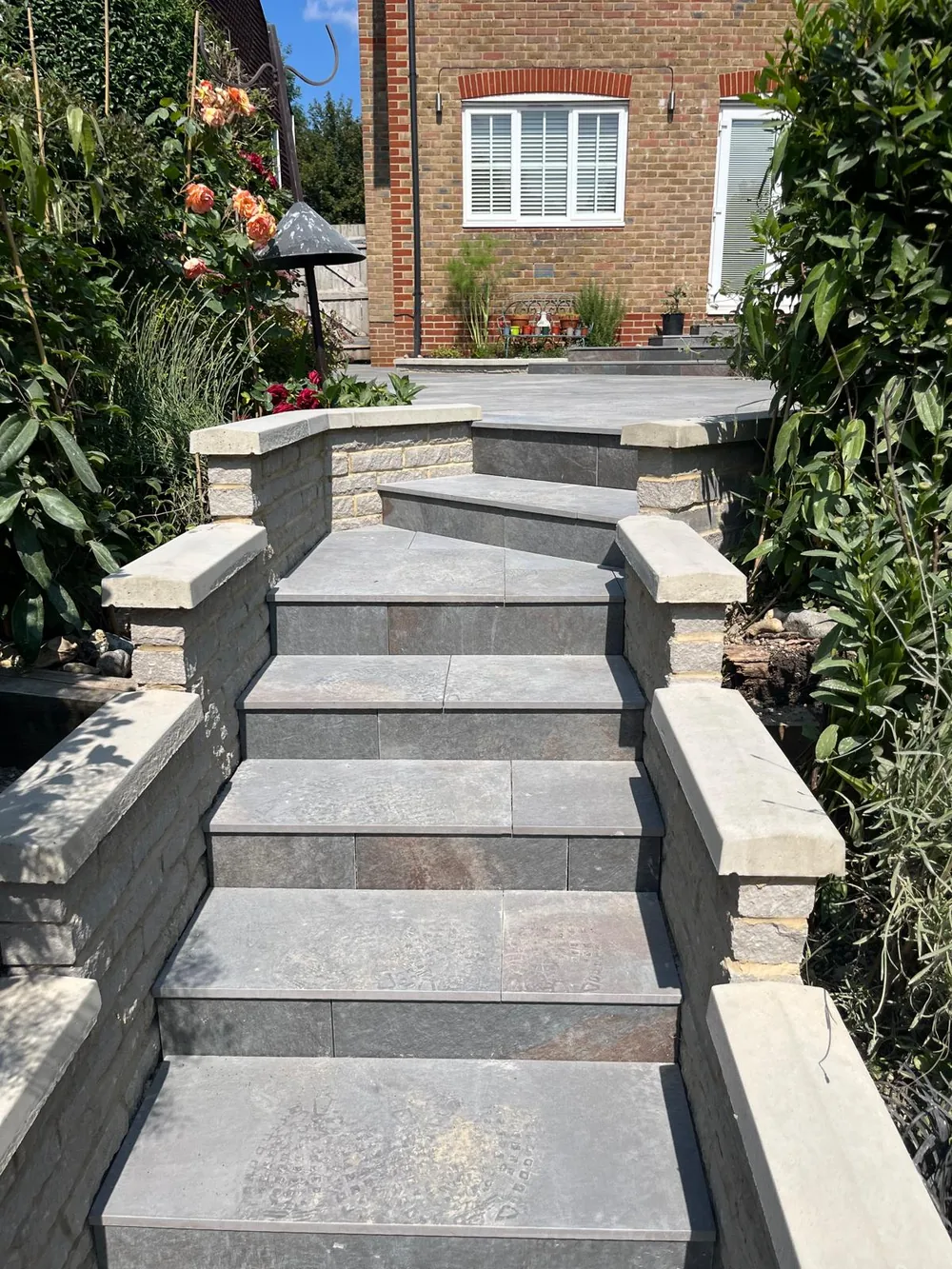
Porcelain
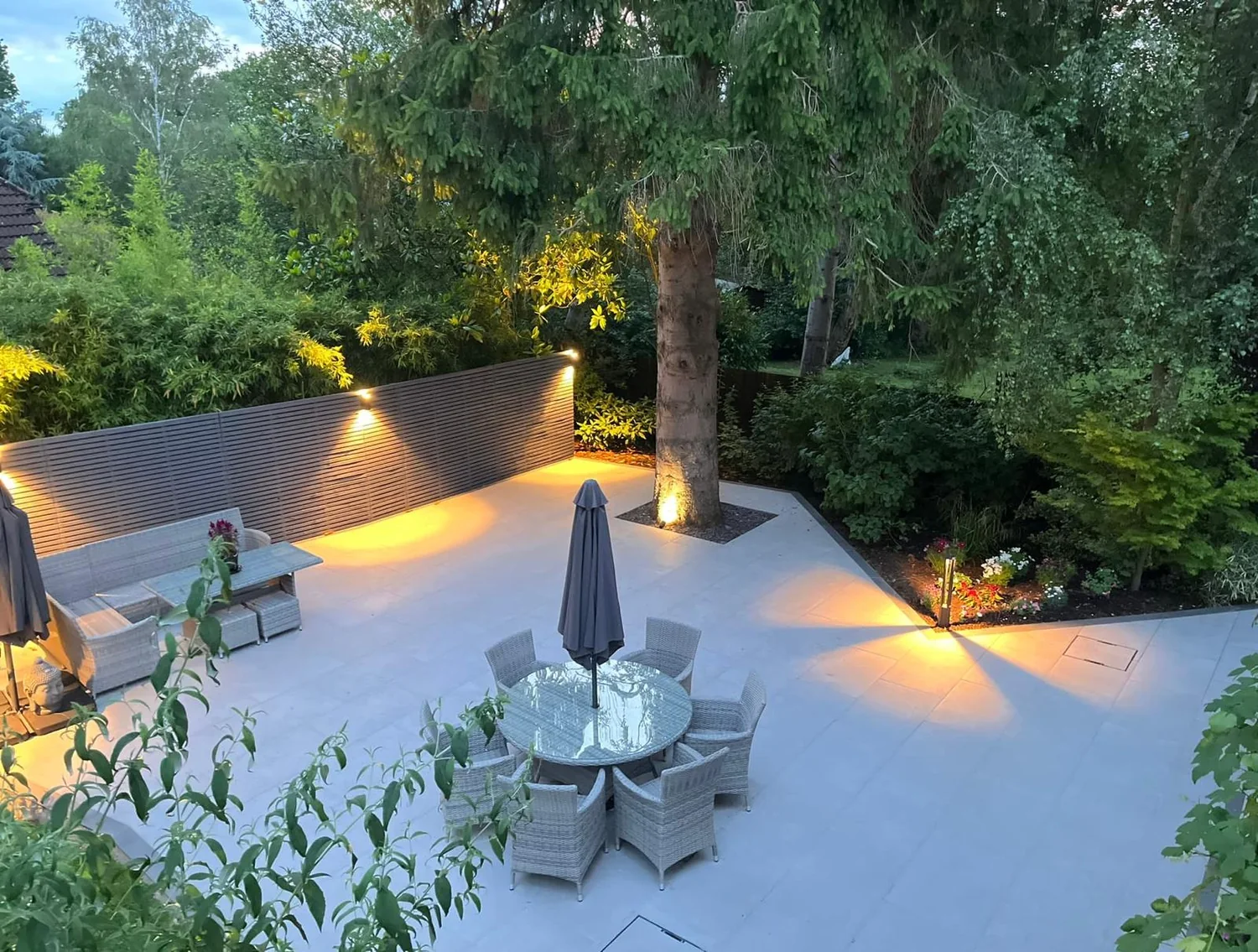
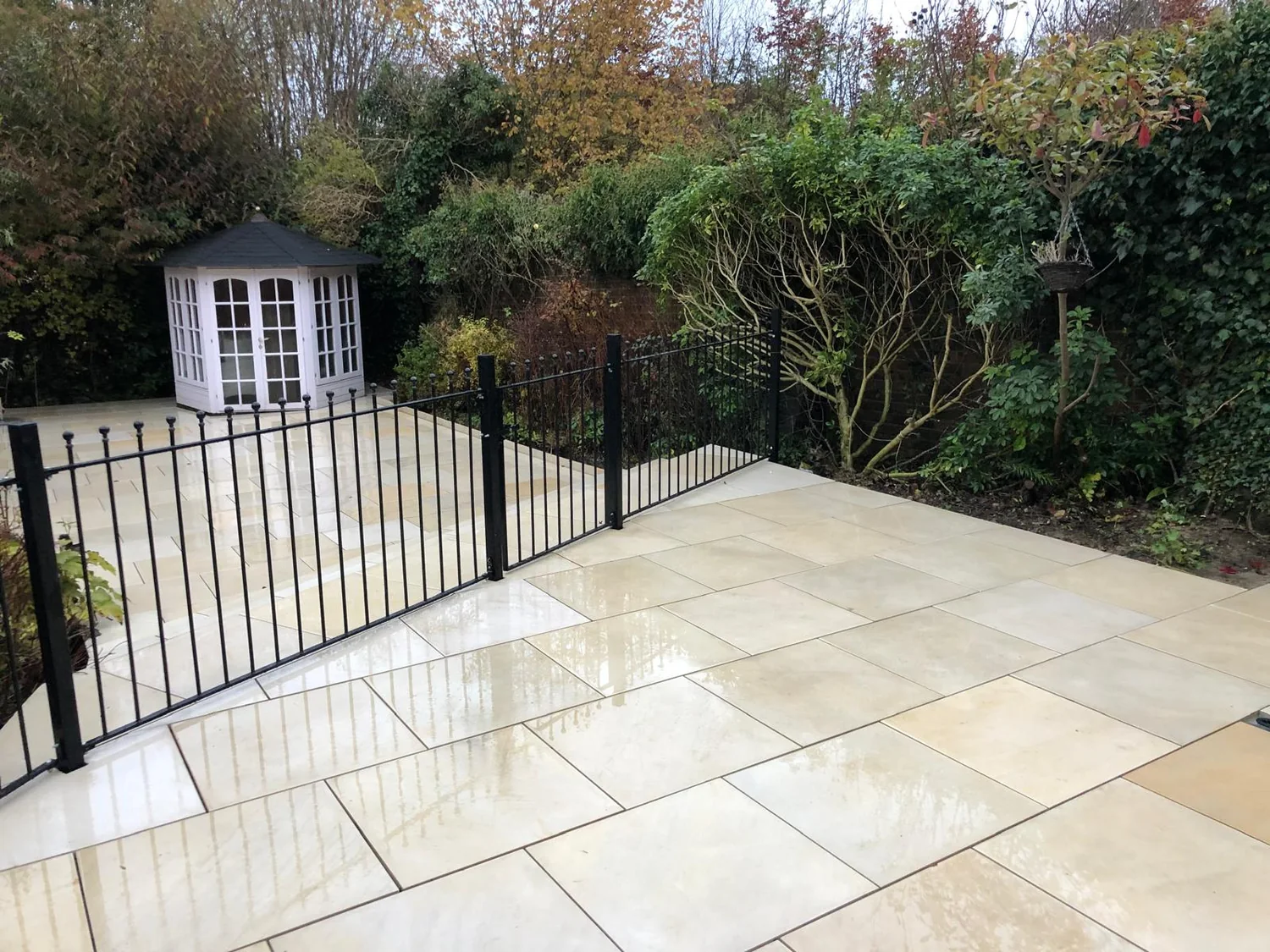
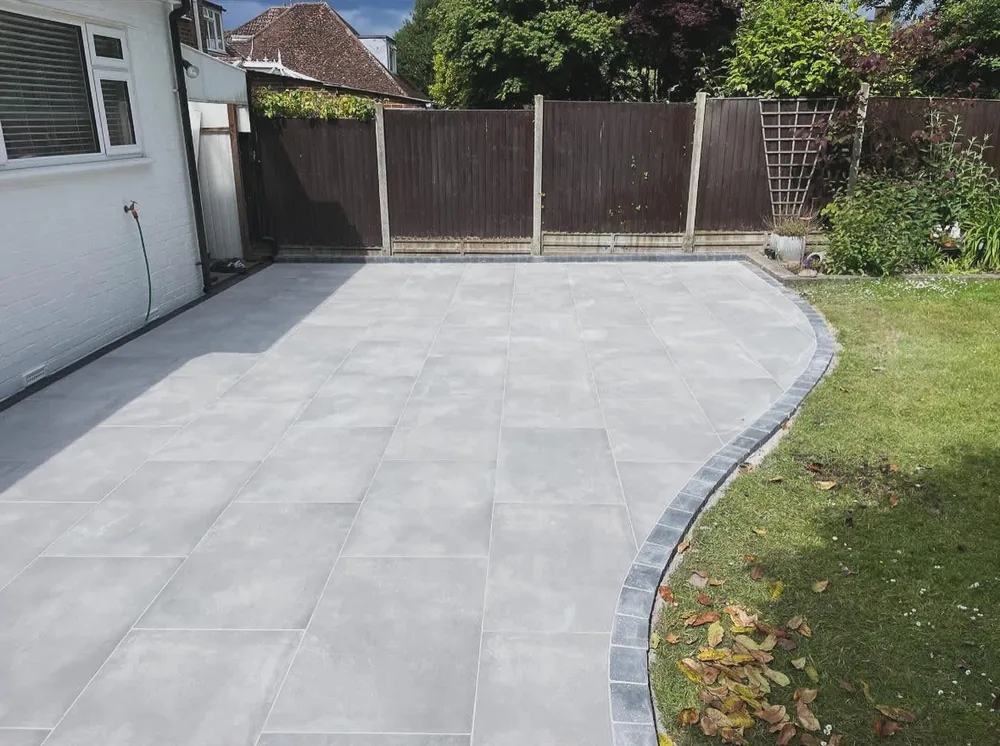
Calibrated, dense and colour stable, with sharp joints and very little upkeep. The easiest surface to keep clean and the least forgiving to lay, because everything is flat and square and any error in the levels shows straight away.

 CROCKETT & CROCKETTPAVING LTD
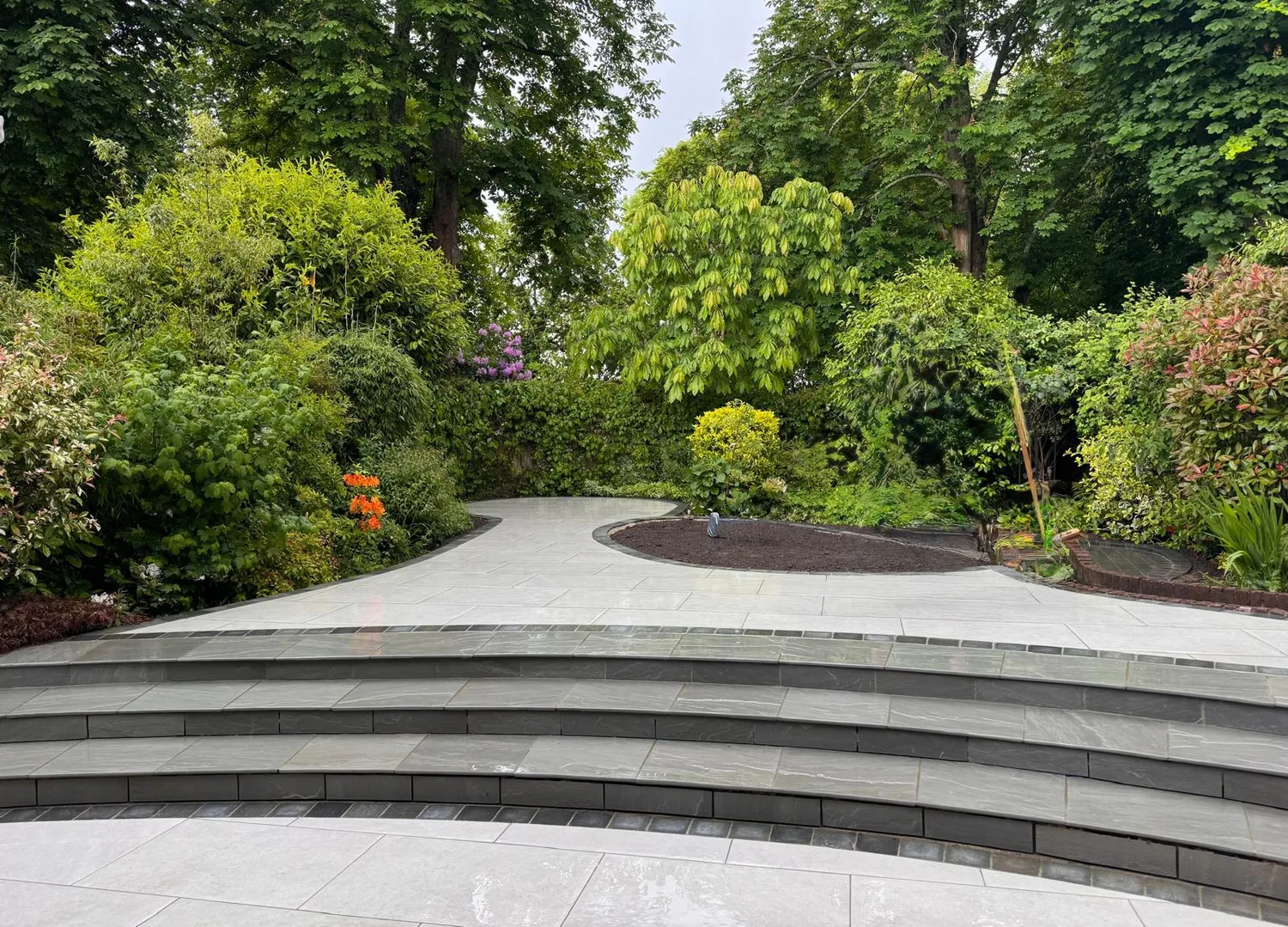
Patios & terraces
A well-designed patio should feel like a natural extension of your home and provide a practical, beautifully finished space for outdoor living.
Four materials
Our approach
Built properly. Finished beautifully.
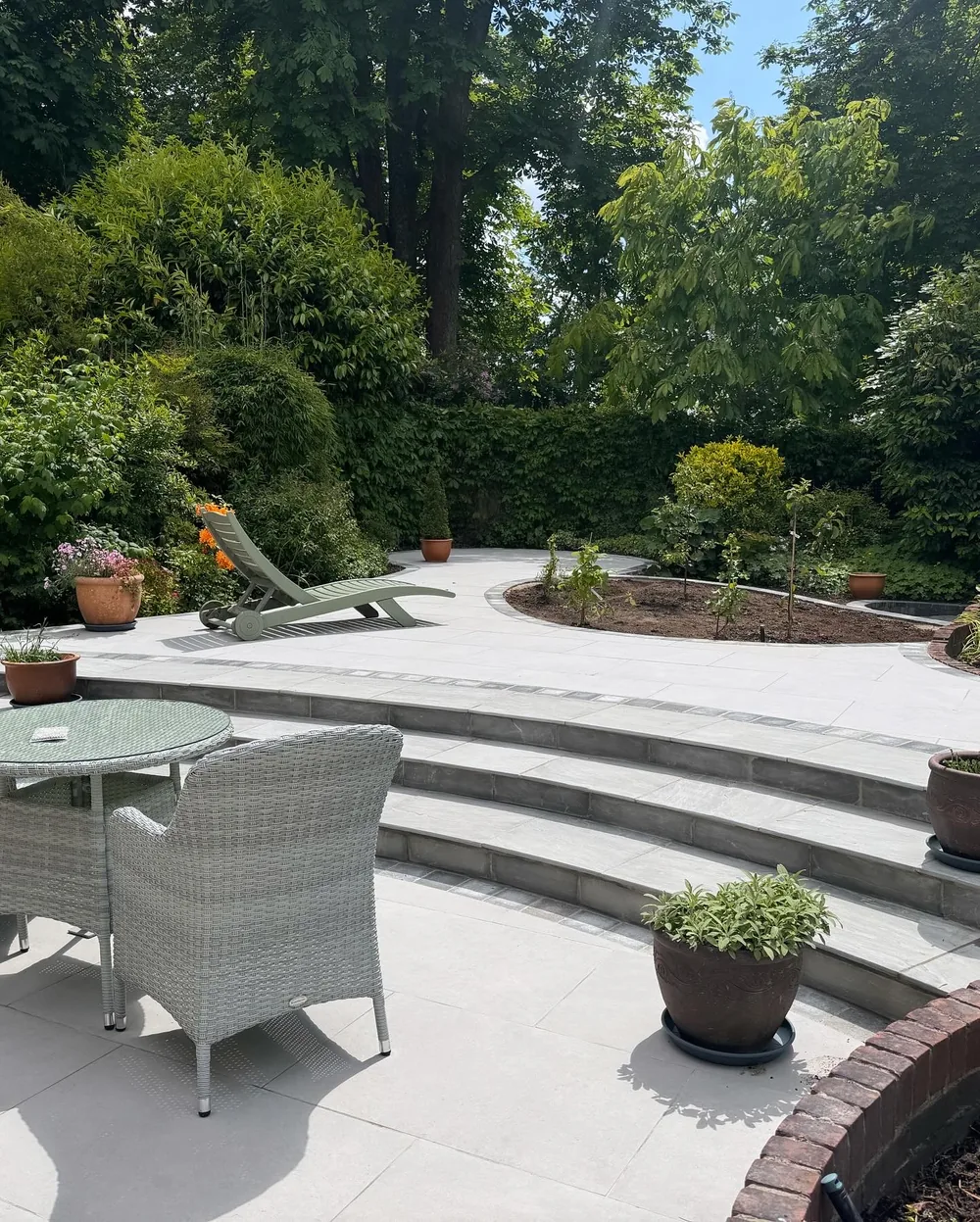
We design and install porcelain and natural stone patios throughout Surrey, carefully considering layout, levels, drainage, access and the relationship between the house and garden.
Every installation is professionally prepared and constructed to provide a precise finish and lasting performance.
No two gardens or properties are the same. We consider how the space will be used, the architecture of the home, existing and proposed levels, drainage and surrounding landscaping before recommending the most suitable design and materials.
Materials
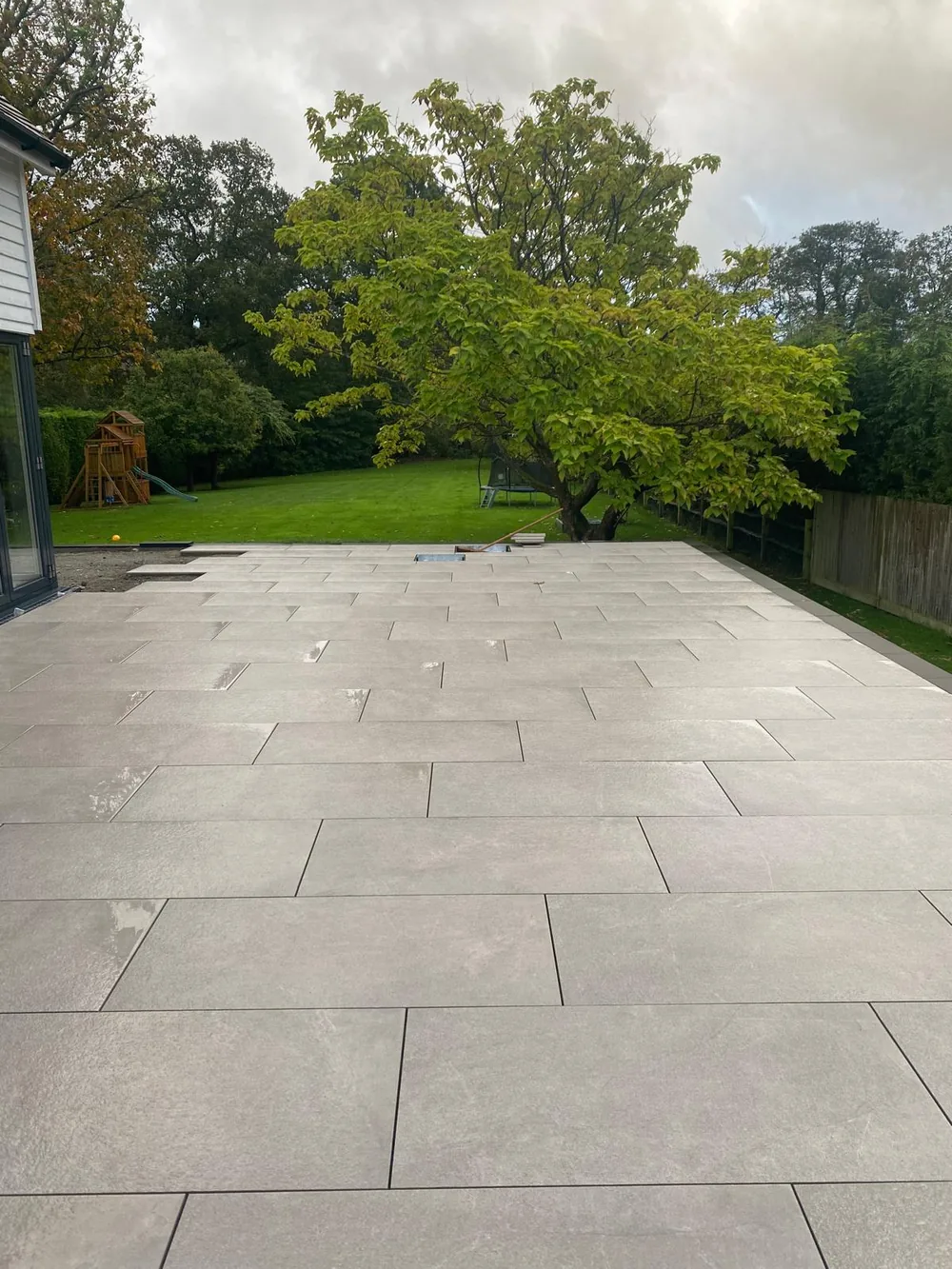
Porcelain is dense and takes on almost no water, so it does not stain easily, it does not fade and frost has nothing to get hold of. It is calibrated, meaning every slab is the same thickness, which gives perfectly flat joints. It also has to be cut wet with a diamond blade and it will not bond to mortar without a slurry primer on the back. Indian sandstone is warmer, riven or sawn, hand split so thicknesses vary, and being porous it darkens in the rain and takes on a patina.
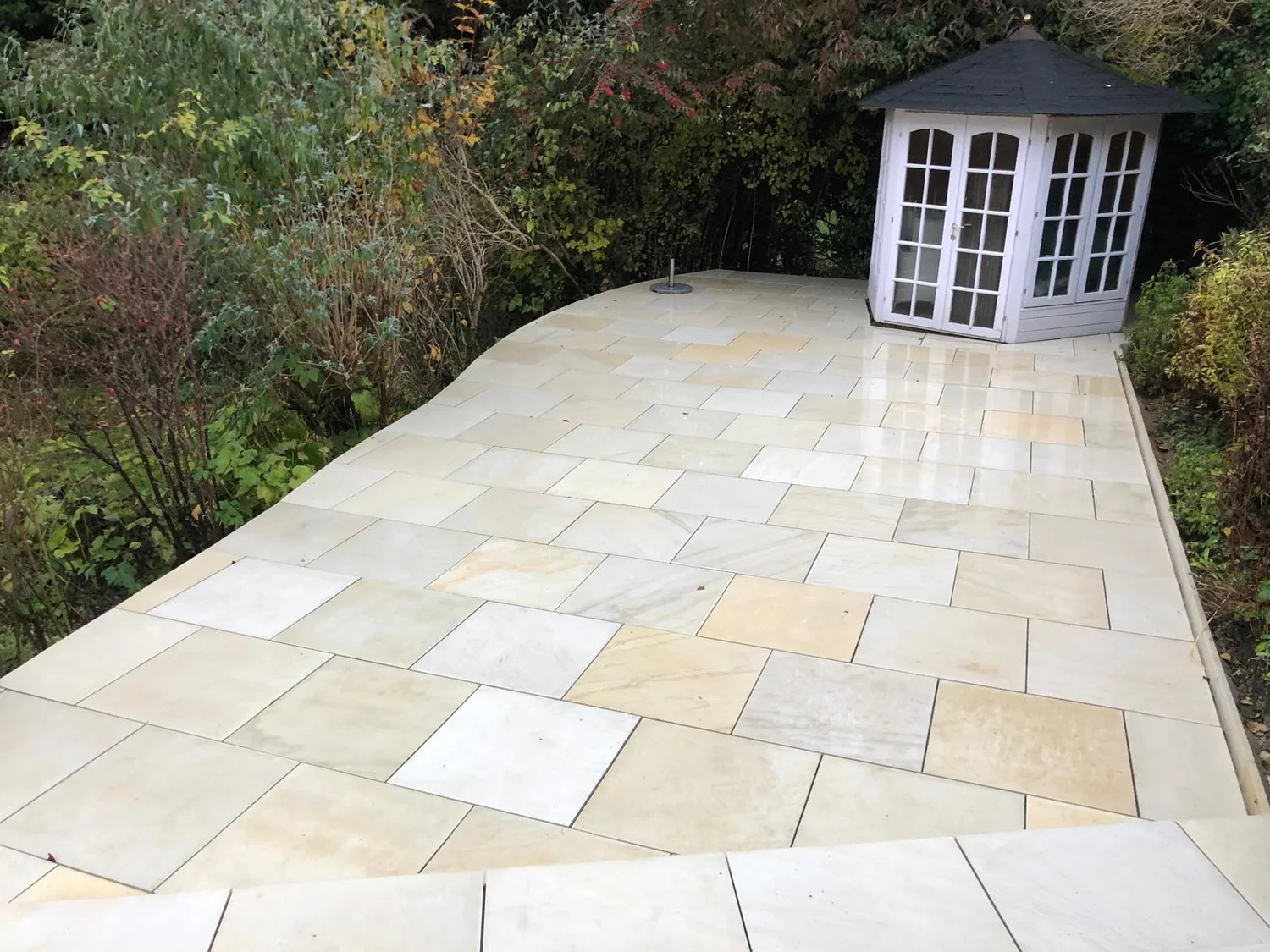
Granite is the hardest of the four and keeps its grip when wet, which makes it sensible for steps and for a terrace on the shaded side of a house. Sawn stone is cut flat on all faces and reads modern and crisp. Riven stone is split along its natural bed and reads traditional, with a thickness the bedding has to follow slab by slab.
The bed
Spot bedding is the quickest way to lay a patio and the most common reason one fails. Five dabs of mortar leave a void under the middle of every slab. Water gets into that void through the joints, sits there, freezes, and the slab either cracks across the hollow or lifts at a corner. A full wet bed fills the whole footprint, so the slab is supported everywhere and there is nowhere for water to gather.
Natural stone and porcelain will not bond to mortar on their own. Stone carries a fine dust from sawing, and porcelain has a surface so tight that nothing keys into it. A slurry primer painted onto the back of each slab just before it goes down is what glues the two together. Without it the slabs sit loose, tapping underfoot within a year or two, however good the mortar below them was.
Falls and the damp proof course
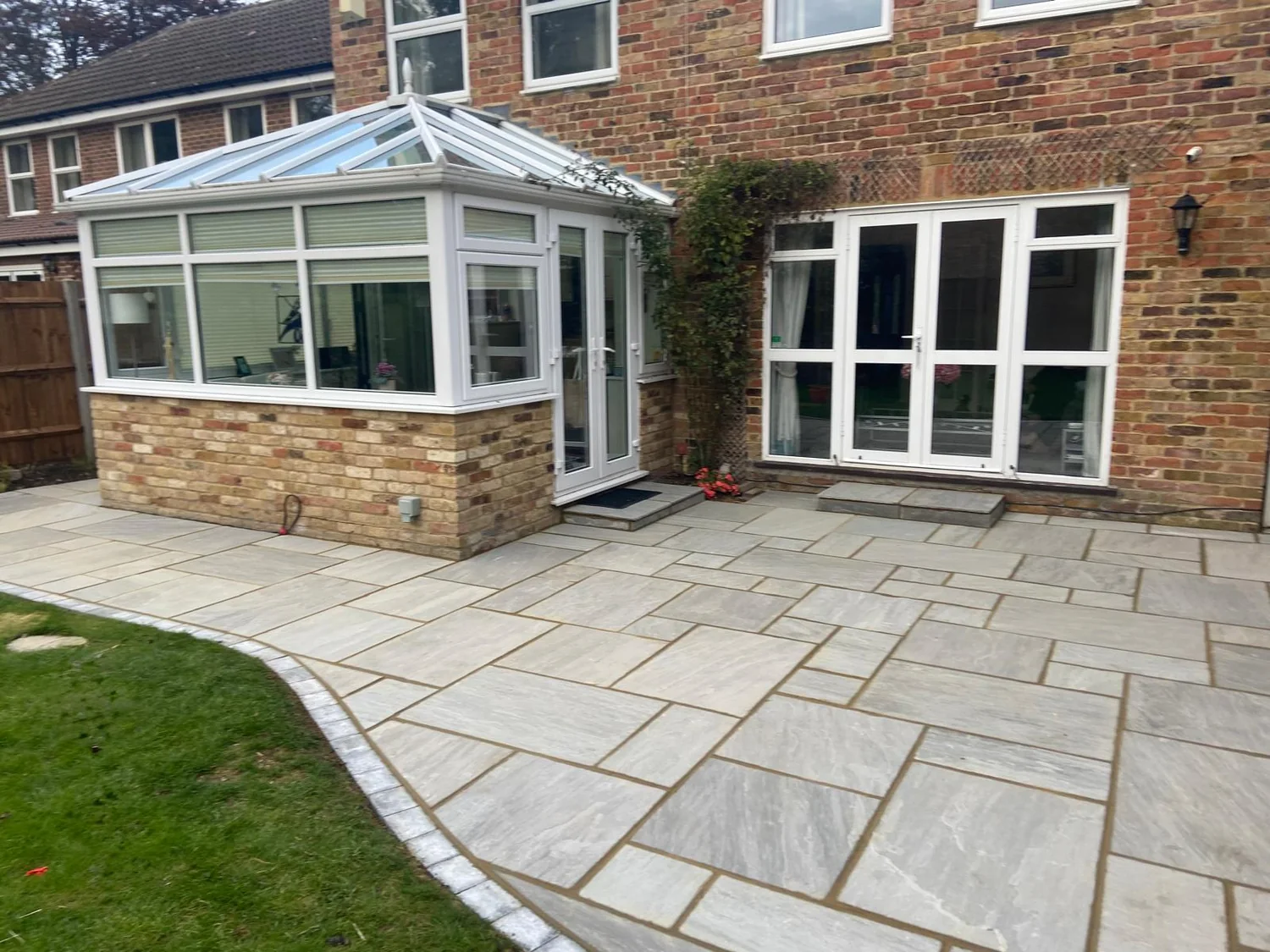
Paving is not waterproof and is not meant to be. Rain is supposed to run off it. A terrace laid perfectly flat holds a film of water across the whole surface, which is where the green film and the slippery patches come from, and in winter that water freezes in the joints and works the pointing loose. A fall of around one in eighty, roughly 12mm for every metre, clears it.
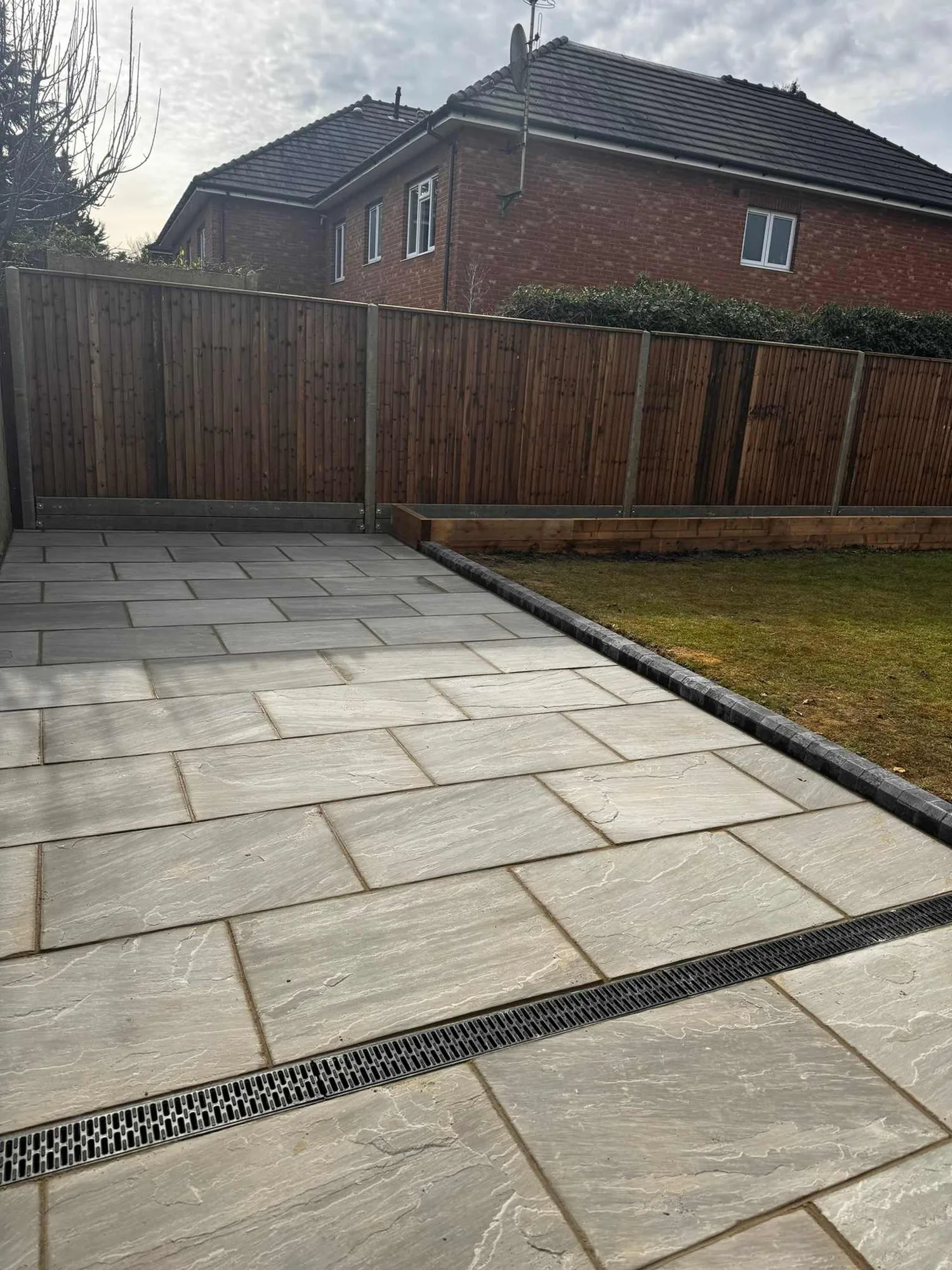
The other line that sets the levels is the damp proof course. Paving finishing too close to it lets driving rain splash above the barrier and lets water sit against the brickwork, and damp inside the house is a far more expensive problem than a patio. Where the levels genuinely will not allow enough clearance, a channel drain or a recessed gulley run along the wall keeps the paving clear and takes the water away to a soakaway or an existing drain.
What we lay
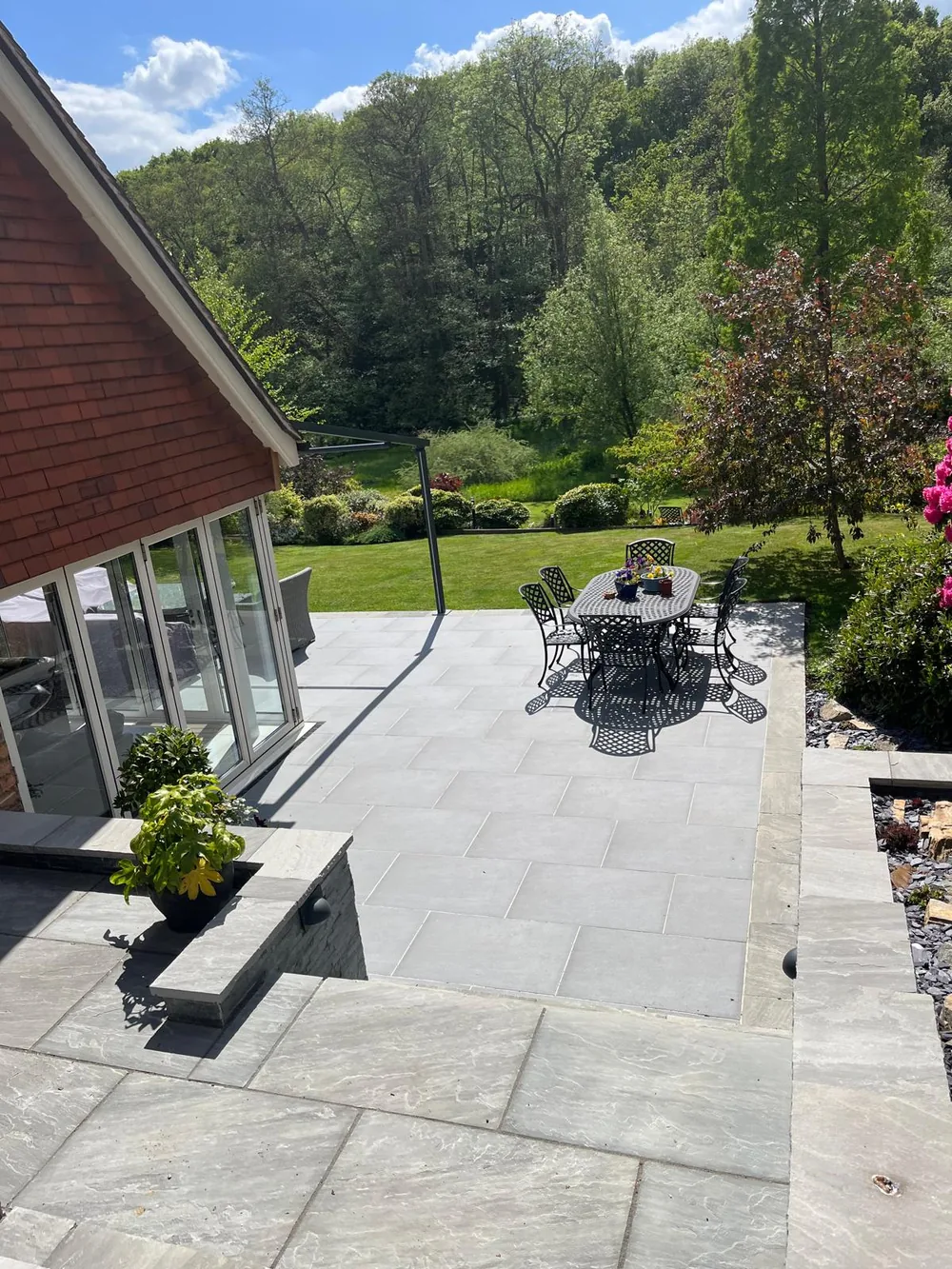
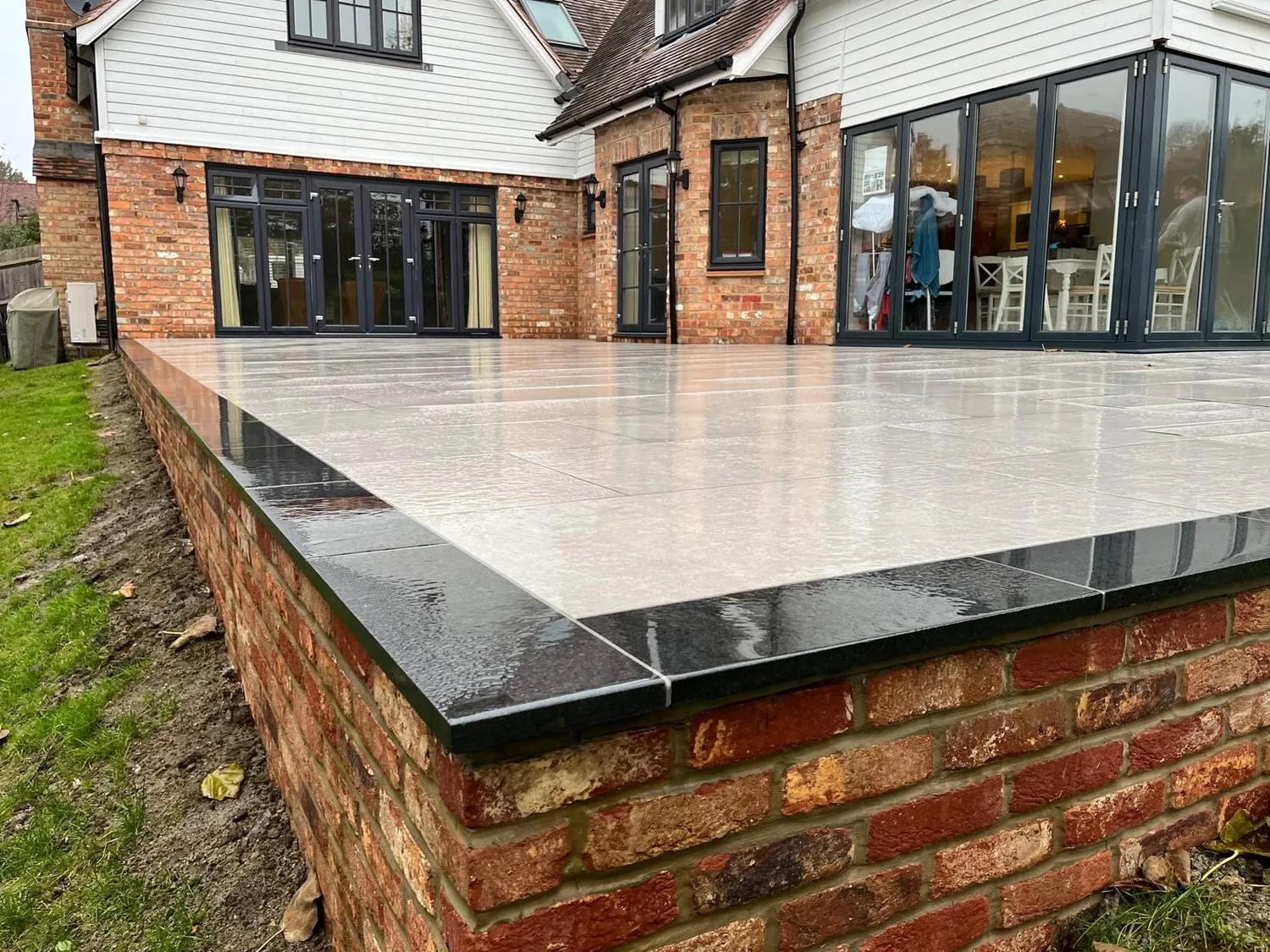
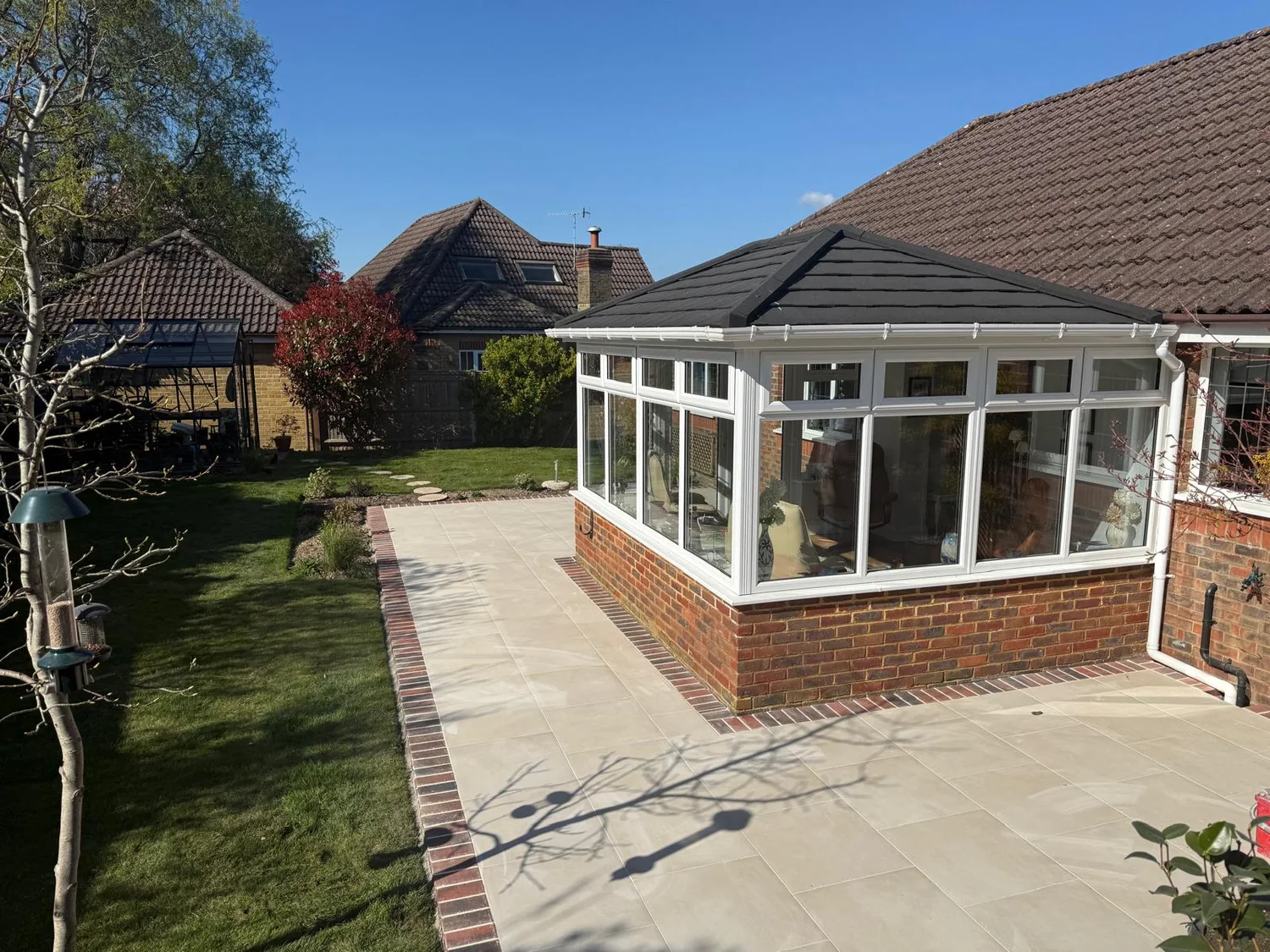
Calibrated, dense and colour stable, with sharp joints and very little upkeep. The easiest surface to keep clean and the least forgiving to lay, because everything is flat and square and any error in the levels shows straight away.
Warm, hand split or sawn, and the most familiar patio stone in Surrey gardens. Riven packs vary in thickness, so the bed is worked slab by slab. It is porous, so it darkens in rain and mellows over the years.
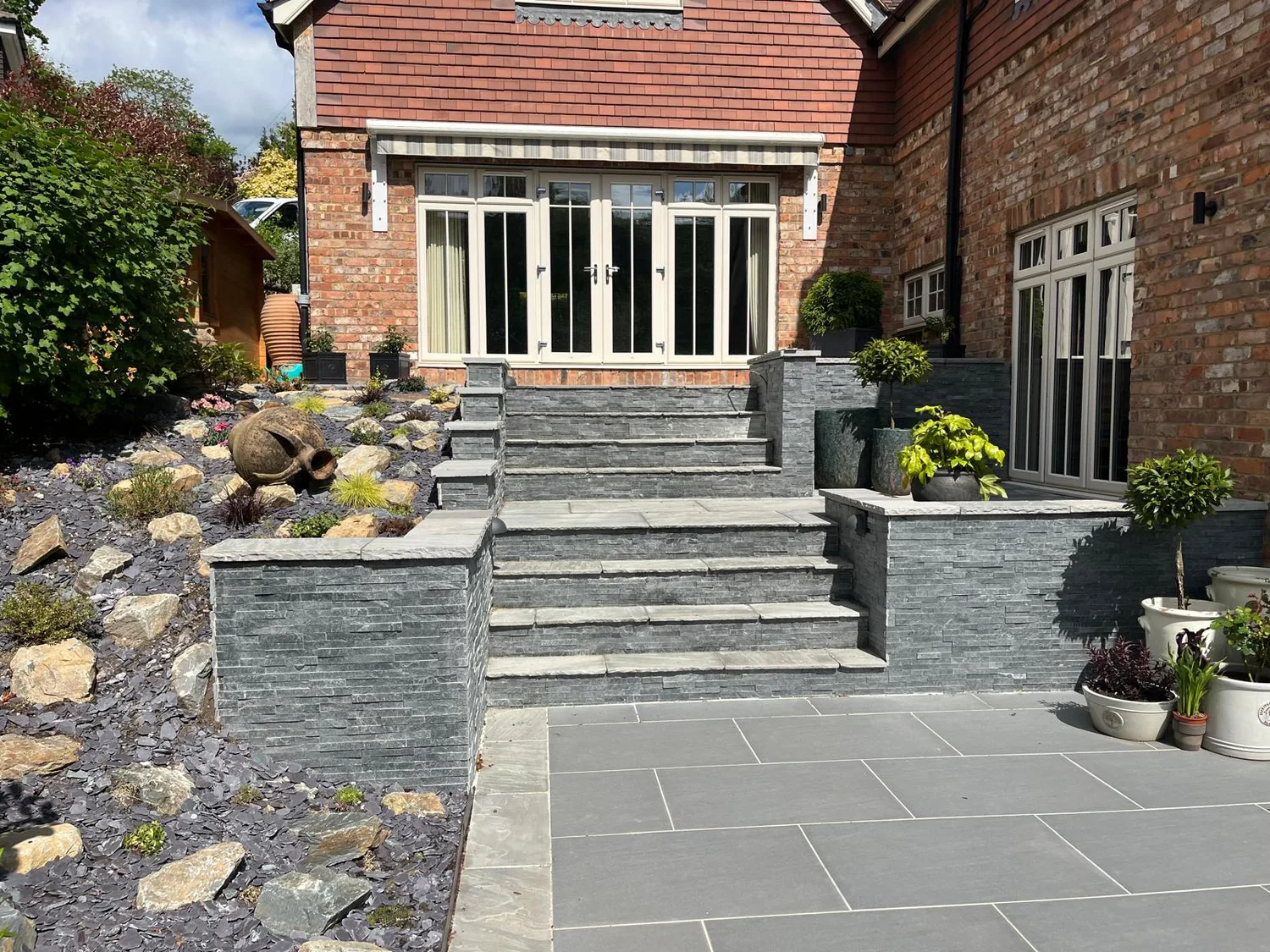
Hard, dense and slip resistant when wet. Good for steps, thresholds and shaded terraces where sandstone would green over. Setts also make a neat border or a change of surface where a patio meets a path or a drive.
Consistent sizes, a wide range of textures and colours, and a materials guarantee from the manufacturer on the product itself. We are accredited on the Marshalls Register and are a Bradstone assured installer, so their ranges go down to the published detail.
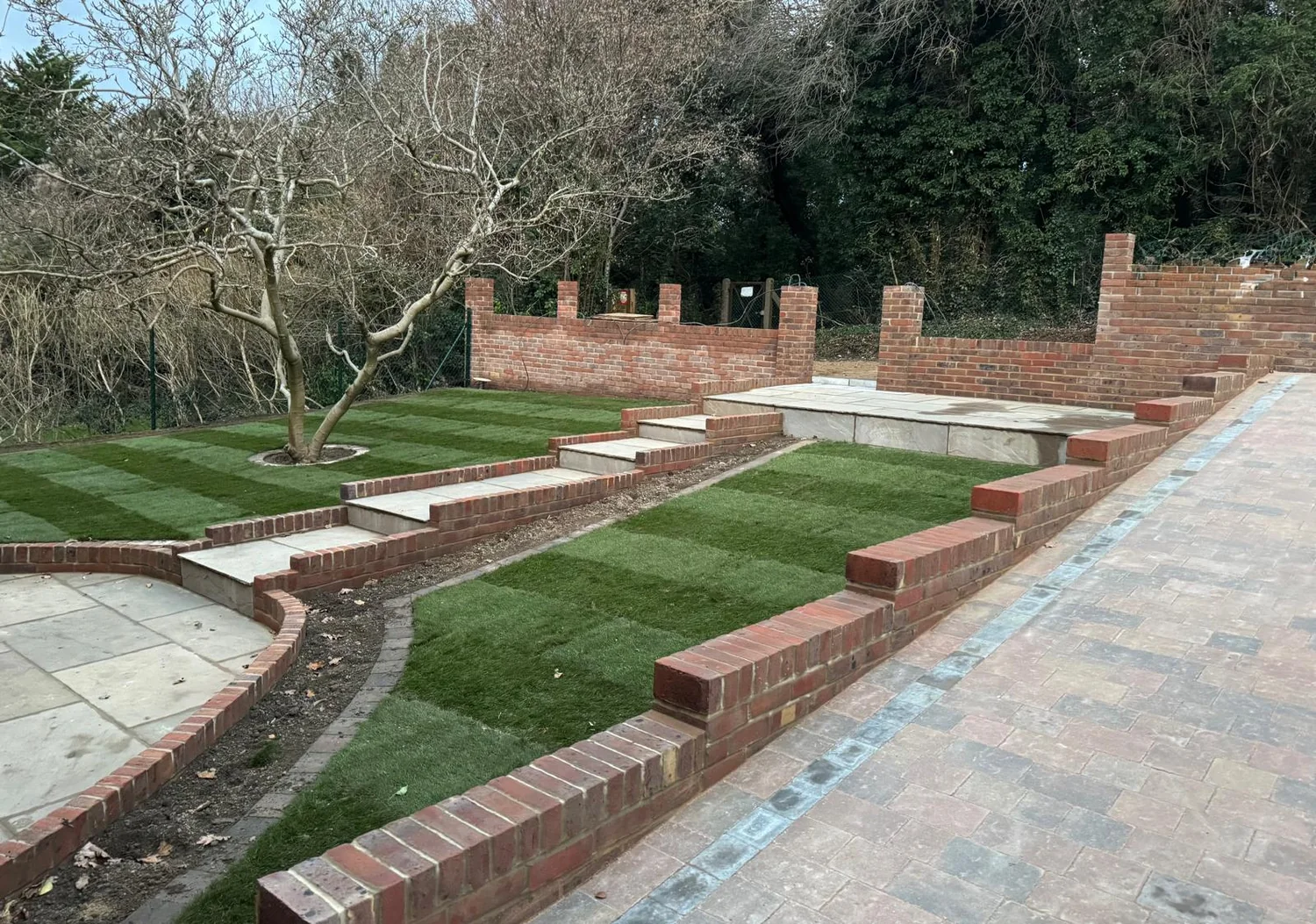
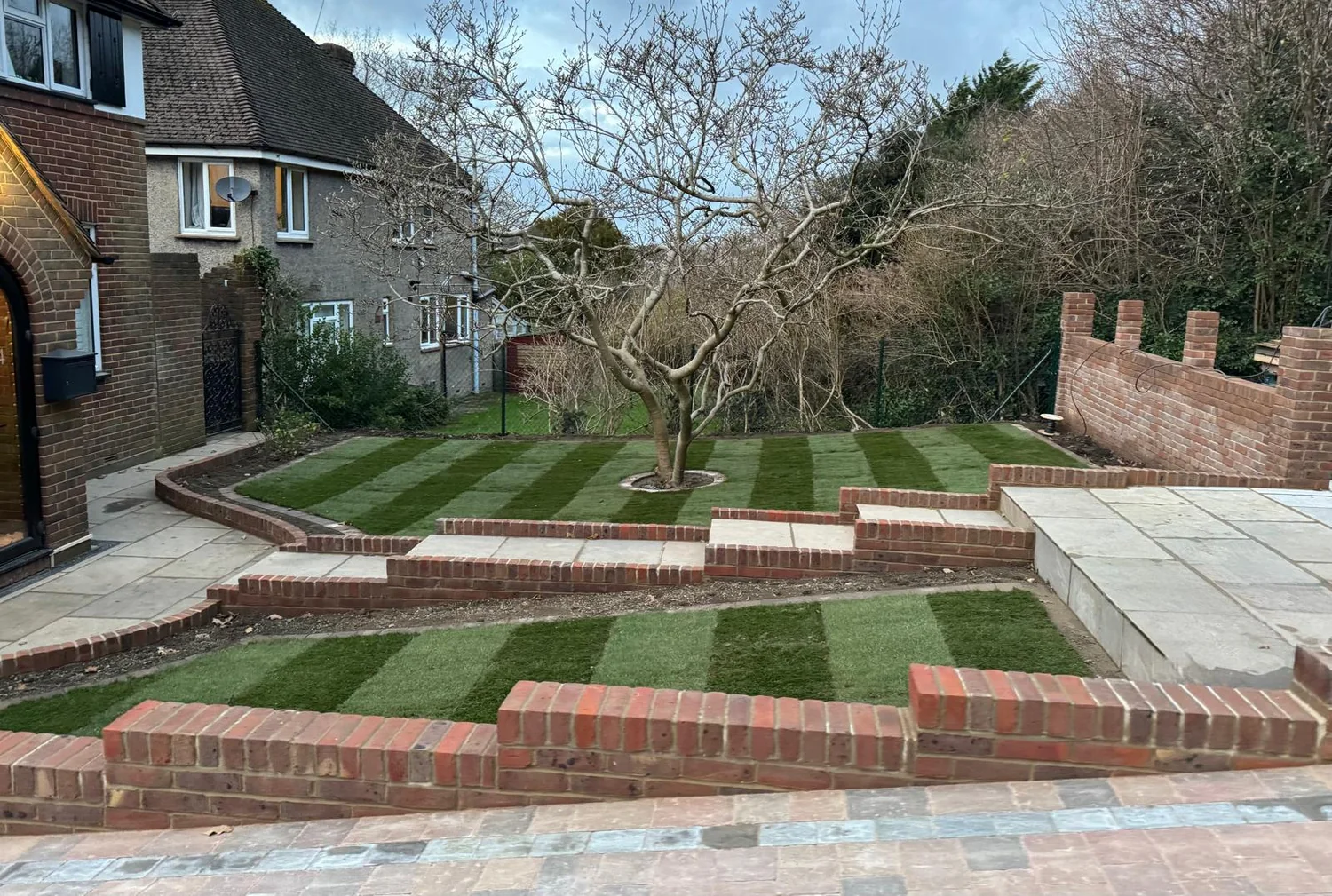
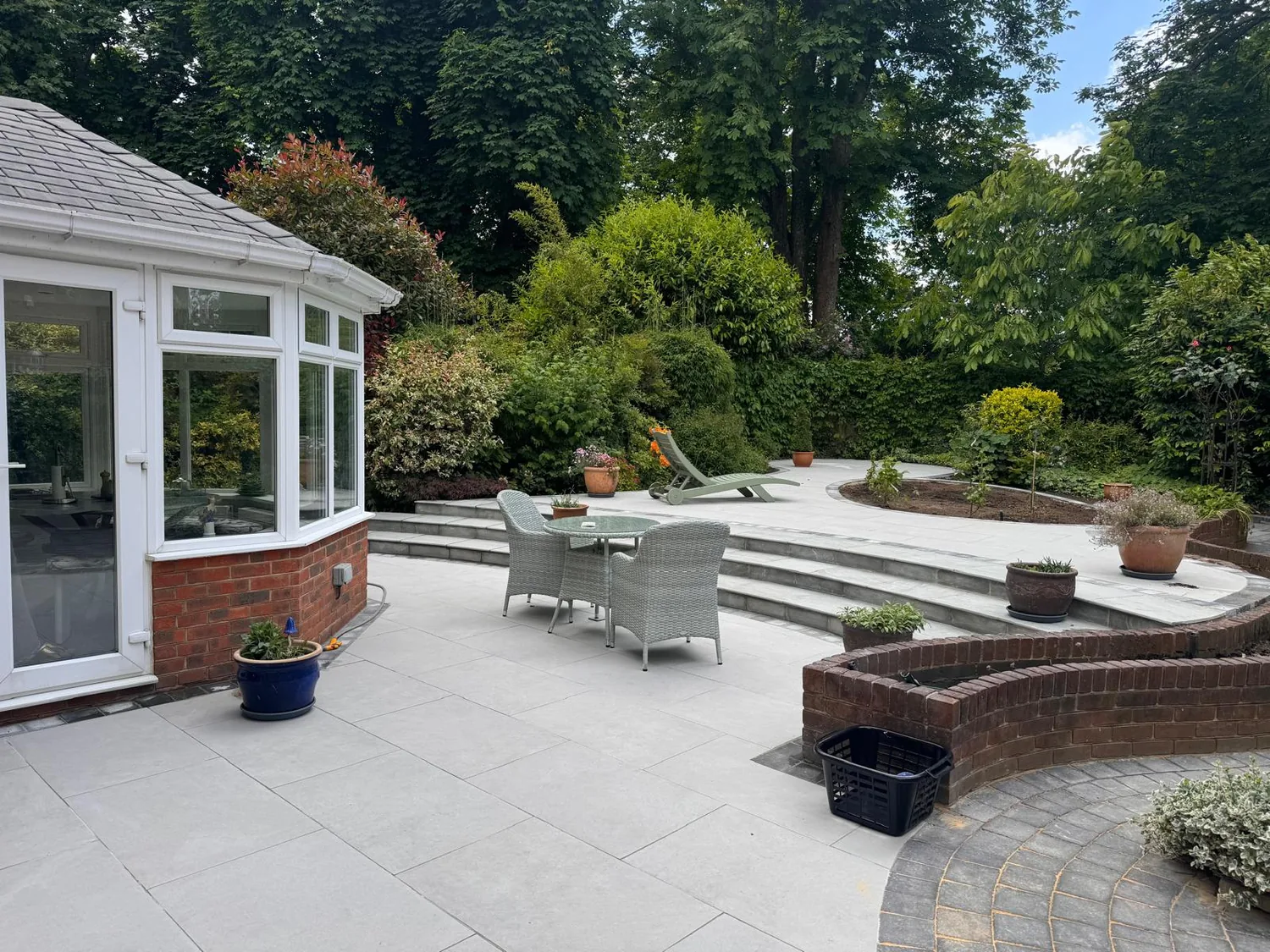
Where a garden changes level, the steps decide how the terrace feels. Even risers, a consistent going, a nosing that sheds water, and an edge detail that ties the patio into the lawn, the wall or the door threshold.
Channel drains across French doors, gullies at the low points, and a run to a soakaway or an existing drain. Quoted with the patio, dug at the same time, and finished so the grating sits flush rather than proud.
Questions
It depends on the size, the material, how much digging and muck away there is, and whether the levels need steps, a wall or a drain run. A small porcelain terrace on level ground is a very different job to a raised sandstone terrace on a slope. We measure and give you a free written quote.
Nearly always because the falls are wrong or missing. Paving sheds water, it does not absorb it, so a terrace laid perfectly flat keeps a film on the surface and puddles wherever it dips. The slabs are rarely the problem. Adding a fall afterwards means lifting and relaying the lot.
Around one in eighty, which works out at roughly 12mm of drop for every metre. That is enough to clear rainwater and gentle enough that furniture sits level and nobody notices it underfoot. The fall should run away from the house towards a lawn, a border, a gulley or a channel drain, never back towards the brickwork.
That is spot bedding. Five dabs of mortar under each slab leave a hollow in the middle, water gets in through the joints and sits there, and frost does the rest. Missing primer causes the same symptoms, because stone and porcelain will not bond to mortar without a slurry coat on the back.
The paving should finish clear of the damp proof course, usually a couple of brick courses below it, so rain cannot splash above the barrier or sit against the wall. Where the levels genuinely will not allow that, the usual answer is a channel drain or a recessed gulley along the wall, carrying the water away.
Porcelain if you want a flat, sharp, low maintenance surface that keeps its colour and stays clean. Sandstone if you want warmth, texture and a surface that weathers into the garden. Porcelain costs more to buy and takes longer to cut. Sandstone is porous, so it greens up faster in shade.
A patio laid at ground level in a back garden is normally permitted development. A raised platform is treated differently, and once it stands more than 300mm above the surrounding ground it usually needs permission. Listed buildings, conservation areas and some newer estates carry their own conditions, so we will say if yours needs checking.
Yes. We are in Caterham, so CR3 and the neighbouring RH postcodes are local ground, and we work right across Surrey and into the bordering parts of south London and Kent. Warlingham, Whyteleafe, Oxted, Godstone, Caterham on the Hill, Purley, Redhill and Reigate are all places we build regularly.
Our work
Get a quote
The slabs are only part of a patio. The bed, the falls and the drainage decide how well it lasts, and every quotation sets them out.
Arrange a free site visit
Tell us a little about the project and we will come out, look at the ground and put a written quotation together.
Where we work
Based in Caterham, we undertake projects throughout Surrey and selected areas of Kent and West Sussex. For larger or more comprehensive projects, we are happy to consider work further afield.